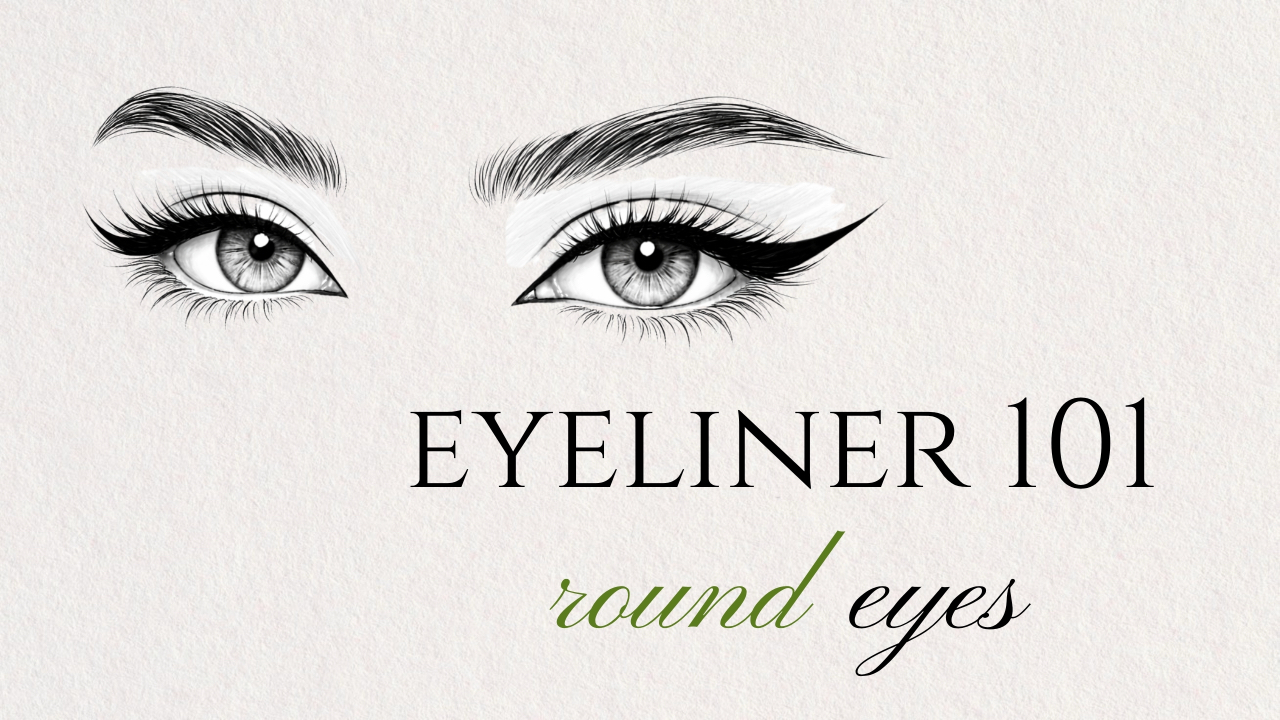
Eyeliner for round eyes is not about making your eyes "less round." It is about learning where to put direction so your natural openness looks intentional, lifted, and balanced. Round eyes already have brightness, visibility, and expression; the right liner teaches that openness where to travel.
If every winged eyeliner tutorial has made your liner look too thick, too curved, too low, or too cartoonish, the problem is probably not your hand. It is the map. Round eyes need a different map than almond eyes, hooded eyes, or downturned eyes. This guide will take you from "I do not know where the line goes" to "I can diagnose my eye shape, choose the right formula, and fix the liner before it ruins the look."
How to Tell If You Have Round Eyes
Look straight into a mirror with your face relaxed. Do not raise your brows, smile, squint, or tilt your chin. Round eyes usually have three visible signals: the center of the eye looks tall, the iris looks more exposed, and the outline reads open or circular instead of tapered.
The quickest test is the iris test. If you can see white above or below your iris when looking straight ahead, your eyes lean round. If your iris touches both the top and bottom lid and the corners taper into a longer shape, you lean almond. If the upper lid fold hides your crease or liner when your eyes are open, you may be round and hooded. If the outer corner sits lower than the inner corner, you may be round and downturned.
Open Center
Visible height through the middle of the eye, often with white showing above or below the iris. Liner goal: add sideways direction.
Tapered Corners
Iris usually touches both lids, and the inner and outer corners look naturally pointed. Liner goal: follow or exaggerate the existing taper.
Hooded or Downturned
Hooding changes lid space. Downturn changes corner angle. Either can overlap with roundness, so use the round-eye rules plus the overlap fixes below.
Here is the part most people miss: "round" describes the outline of the eye, not the whole eye area. You can have big round eyes, small round eyes, deep-set round eyes, protruding round eyes, mature round eyes, or round eyes with very little lid space. That is why one viral eyeliner hack can look perfect on one round eye and strange on another.
Use this final check before you choose a look: ask what you want the liner to do. If you want the eye to look longer, build the outer third. If you want it to look lifted, angle the tail slightly upward. If you want it to look more doll-like, keep the center bright. If you want it to look smoky, diffuse the edge instead of drawing a hard ring.
Take our free Eye Shape Identifier quiz to confirm your shape in under a minute, then come back and follow the liner map built for it. If you turn out to be round and hooded or round and downturned, the quiz will tell you, and the overlap sections below have you covered.
Why Round Eyes Need Direction
Round eyes naturally pull attention to the center. That is why a thick line above the pupil often makes the eye look rounder: it reinforces the tallest part of the shape. A full black ring does the same thing from every side. It creates a circle around a circle.
Flattering eyeliner for round eyes works more like an arrow than a frame. The inner third stays light, the center stays thin, and the outer third carries the weight. That outer weight can be a crisp wing, a smudged brown haze, a tightline lift, a lower outer flick, or a graphic dash. Different looks, same architecture.
If the liner makes the eye look heavy, start by removing product from the inner third and center before changing the wing.
The 2025-2026 trend cycle actually helps round eyes. Brown liner is everywhere because it gives definition without the hard contrast of black. Tightlining and lash-line enhancement are back because they make lashes look fuller without covering the lid. Graphic liner and lower-lash liner are back too, but for round eyes those trends work best when they live outside the eye or on the lower outer third, not wrapped around the whole waterline.
The 5 Placement Rules That Change Everything
These rules matter more than the product. A luxury liner in the wrong place will still make round eyes look smaller, and a drugstore pencil in the right place can look expensive.
Keep the inner third bare or hairline-thin. Heavy inner liner pulls the eye inward and makes round eyes look shorter.
The center is already the tallest point. Keep liner thinnest above the pupil unless your goal is a deliberately doll-like eye.
Build thickness only after the outer edge of the iris. This gives the eye horizontal pull without hiding the open center.
A round-eye wing should stretch outward more than upward. Tall triangular wings often curve with the eye and exaggerate roundness.
If you line underneath, keep it under the outer third or outer half. Leave the lower inner corner clean unless you want a strong editorial look.
Watch winged liner mapped to each eye shape, round included:
See round-eye liner placement in motion:
Your Round-Eye Liner Map
Before any product touches your eye, map three points. Point A is the outer edge of your iris. Point B is your outer corner. Point C is the direction you want the liner to travel. Most round-eye liner starts at A, gets stronger at B, then extends toward C.
For a lifted look, C points toward the tail of your brow. For an elongated look, C points toward your temple. For a puppy or K-beauty-inspired look, C follows the lower lash line slightly downward or almost straight out. For mature or hooded-round eyes, C must be checked with your eyes open because folds, texture, and skin movement can change the final shape.
Draw the wing guide with your eyes open, then close your eye only to fill small gaps. The open-eye view is the real result; the closed-eye view is just your work surface.
If you are a beginner, do not start with a full upper lash line. Start with the outer third only. Once that looks flattering, you can decide whether the inner lash line needs anything. Most of the time, it needs less than you think.
Step-by-Step Look 1: The Beginner Outer-Third Wing
This is the look I would teach first because it gives the most improvement with the least risk. It works for big round eyes, small round eyes, and round eyes that get overwhelmed by full liner.
Best for: everyday makeup, beginners, round eyes that look smaller with liner, and anyone who wants a soft almond effect.
Use: a brush-tip liquid liner, a micro gel pencil, or dark brown shadow on an angled brush.
- Curl your lashes first so the lash line is visible.
- Look straight ahead and mark a tiny dot just past the outer corner, angled slightly toward your temple.
- Place your liner at the outer edge of your iris, not at the inner corner.
- Draw a thin line from the outer iris to the outer corner.
- Connect the outer corner to the dot with a short, slim flick.
- Thicken only the last few millimeters near the outer corner.
- Add mascara mainly to the upper outer lashes.
The finished liner should feel almost incomplete up close. That is normal. From conversational distance, the missing inner liner reads as brightness, not emptiness.
Step-by-Step Look 2: The Straight Cat Eye for Round Eyes
The classic cat eye often fails on round eyes because people copy a curved, swoopy wing. On a round eye, that curve can echo the eye's circular shape. A straighter cat eye is more flattering because it visually stretches the lid.
Best for: evening makeup, photos, big round eyes, and anyone who wants a sharper effect.
Use: a precise liquid pen. The stila Stay All Day Waterproof Liquid Eye Linerin Intense Black is a dependable crisp-liner option, and NYX Epic Ink Waterproof Liquid Eyelinerin Black is the budget brush-tip pick.
- Draw the wing first while looking straight into the mirror.
- Keep the wing slim and more horizontal than vertical.
- Connect the tip back to the upper lash line at the outer third.
- Fill the narrow triangle.
- Line from the outer iris to the triangle.
- If you need inner definition, use the leftover product on the tip only. Do not reload the pen for the inner third.
If your cat eye looks round, the wing is probably too curved or the center line is too thick. Flatten the top edge and remove product above the pupil with a pointed cotton swab.
Watch the winged and cat-eye versions on round eyes:
Step-by-Step Look 3: Soft Brown Elongating Liner
Brown liner is the most forgiving round-eye technique for 2026 makeup because it creates shape without the hard border of black. It also plays well with skin-focused makeup, softer brows, satin complexions, brown mascara, and the current return of wearable color.
Best for: daytime, mature eyes, fair lashes, soft glam, bridal makeup, and anyone who feels black liner takes over.
Use: a creamy brown pencil with enough play time to smudge. I like a waterproof pencil here because the smudged shape needs to set. Try Urban Decay 24/7 Glide-On Waterproof Eyeliner Pencilin Whiskey for a classic brown, MAKE UP FOR EVER Aqua Resist Color Pencilin 03 Cool Ebony for deeper brown-black definition, or Kulfi Underlined Kajalin Cheeky Chiku for a warm brown kajal effect.
- Scribble brown pencil into the upper outer lash roots.
- Smudge with a tiny pencil brush before it sets.
- Pull the smudge outward toward your temple, not upward into a round cloud.
- Add the same pencil under the lower outer third only.
- Soften the lower line with brown shadow so it fades before the center of the eye.
- Finish with mascara concentrated on the upper outer lashes.
For round eyes, brown often looks more sculpting than black because it creates a shadow instead of a border. Use espresso, bronze, plum-brown, or cool taupe depending on your undertone.
Step-by-Step Look 4: Tightline Lift
Tightlining is one of the best eyeliner techniques for round eyes because it defines the lash base without adding visible thickness to the lid. It is also the look to learn if your round eyes are small, hooded, mature, watery, or easily overwhelmed by makeup.
Best for: no-makeup makeup, mature round eyes, contact lens wearers who tolerate waterline liner, and anyone who wants fuller-looking lashes.
Use: a waterline-safe pencil. The Clinique High Impact Gel Tech Eyelinerin Black is useful because Ulta lists it as waterline-safe, waterproof, ophthalmologist-tested, and suitable for sensitive eyes and contact lens wearers.
- Wash hands before touching the eye area.
- Look down into a mirror.
- Gently lift the upper lid from the center, not by pulling the outer corner sideways.
- Press the pencil between the upper lash roots in tiny sections.
- Concentrate on the outer half if your eyes get irritated easily.
- Blink, wait a moment, then clean any transfer from the lower waterline.
Tightlining should not look like a visible stripe. If you can see a thick black band on the lid, you are drawing above the lashes instead of between them.
Step-by-Step Look 5: Nude Lower Waterline
The lower waterline can make or break round-eye liner. Black on the lower waterline can be gorgeous for editorial or smoky makeup, but it usually makes round eyes look smaller and more circular. A nude pencil keeps the lower rim open while the upper liner creates structure.
Best for: bridal makeup, daytime looks, tired eyes, small round eyes, and smoky looks that need brightness.
Use: beige, cream, or soft peach, not stark correction-fluid white. The SEPHORA COLLECTION 12 Hour Colorful Contour Pencil Eyelinerin 54 Coconut is a soft off-white option; choose a deeper beige if Coconut is too bright for your waterline tone.
- Dry the lower waterline lightly by blinking once onto a clean tissue. Do not rub.
- Glide the pencil along the lower waterline from the outer third toward the center.
- Stop before the inner corner if your eyes water.
- Add upper outer-third liner so the look has shape, not just brightness.
- Use lower mascara sparingly or only at the outer lashes.
If nude liner looks chalky, switch to beige, champagne, or peach. The right shade should look like a cleaner version of your waterline, not a white stripe.
Step-by-Step Look 6: Reverse Kitten Liner
Lower-lash liner is a major 2026 trend, from mod-inspired lower strokes to smoky under-eye definition. Round eyes can wear it, but the adaptation is crucial: keep it on the lower outer third and make the direction outward, not circular.
Best for: trendy makeup, evening looks, round eyes with lots of lid space, and anyone who wants lower-lash definition without closing the eye.
Use: a pencil with play time. MAKEUP BY MARIO Master Pigment Pro Eyeliner Pencilin Super Black gives a strong smoky-black option, while MAKE UP FOR EVER Aqua Resist Color Pencilin 04 Limitless Brown keeps the trend softer.
- Tightline or draw a very thin upper outer-third line first.
- Place pencil beneath the lower outer third, under the lashes rather than inside the waterline.
- Smudge outward with a small angled brush.
- Keep the inner lower lash line completely clean.
- Optional: add a nude pencil to the lower waterline for contrast.
For round eyes, the lower line should look like a shadow that points outward. If it looks like a semicircle under the eye, remove the center and inner section.
Step-by-Step Look 7: Puppy Liner for Round Eyes
Puppy liner is often associated with K-beauty and softer eye makeup. Instead of lifting the wing dramatically upward, it follows the natural lower lash direction outward or slightly downward. On round eyes, it can look sweet, elongated, and modern when it stays slim.
Best for: very round or doe-like eyes, soft makeup, younger-looking styles, and anyone whose upturned wing always curves strangely.
- Line the upper lash line from the outer edge of the iris to the outer corner.
- Extend the line almost straight out, following the lower lash direction.
- Keep the flick short, about the length of two or three lashes.
- Add a tiny shadow connection under the lower outer corner if desired.
- Avoid thick black liner across the center of the lid.
Puppy liner is not automatically droopy. It becomes droopy when the tail is too long, too thick, or too low. Keep it delicate and let mascara lift the outer lashes.
Step-by-Step Look 8: Graphic Outer Flick
Graphic liner is back, but round eyes need strategic negative space. Instead of drawing a floating line across the tallest center of the lid, place the graphic detail near the outer crease or outer corner so it extends the eye.
Best for: parties, editorial makeup, colorful liner, and round eyes with visible lid space.
Use: a matte liquid liner such as MAKEUP BY MARIO Master Mattes Liquid Eyeliner for black, or a waterproof colored pencil in navy, plum, burgundy, or deep green for a softer graphic line.
- Create a slim outer-third wing first.
- Let it dry completely.
- Add a short floating dash above the outer crease, parallel to the wing.
- Leave the center lid open.
- Skip full lower black waterline unless you want a deliberately dramatic mod look.
The modern version is not about copying a perfect social-media stencil. It is about using negative space to make the eye look designed.
Mature Round Eyes: What Changes
Mature round eyes often still have beautiful openness, but the canvas changes. Skin may be thinner, the outer corner may fold differently, texture may catch liquid liner, and black may look harsher near dark circles or under-eye shadows. The answer is not "stop wearing eyeliner." The answer is to change the formula, pressure, and angle.
Use a pencil, shadow, or gel pencil before liquid if your lid texture makes liquid skip. Keep the line thinner than you think you need. Choose brown, deep gray, navy, plum, or soft black instead of automatic inky black for daytime. Tightline the upper outer half rather than drawing a thick lid stripe. Avoid pulling the outer corner taut because the line will bounce into a different shape when you let go.
What it is: Mapping the wing with pencil or shadow before adding liquid only where crispness is needed.
The concern: Liquid can skip over texture and make mistakes look sharper.
What pros do: Sketch softly, correct the shape, then sharpen only the outer tail.
Bottom line: More control, less cleanup, and a softer finish near texture.
What it is: Espresso, soft black, gray, plum, or navy instead of the blackest black.
The concern: Very dark liner can compete with under-eye shadows and fine lines.
What pros do: Use softer shades for daytime and save crisp black for the outer tail or evening.
Bottom line: You keep definition without making the eye area look heavy.
What it is: Placing the wing while your eye is relaxed and open.
The concern: Closed-eye liner can vanish, kink, or point downward once the eye opens.
What pros do: Mark the visible tail first, then fill tiny gaps with the eye closed.
Bottom line: Your liner works with real-life skin movement.
For mature round eyes, I usually prefer this formula order: tightline first, soft pencil at the outer third second, mascara third, liquid tail only if needed. That sequence gives lift before drama, so the final result looks like your eye but more awake.
Hooded-Round Eyes: The Special Case
Round and hooded can overlap, and this is where many tutorials break. The round-eye rule says build the outer third; the hooded-eye rule says keep visible liner away from the fold. You need both.
Start your liner later, around the outer edge of the iris. Keep the lid line thin. Map the tail with eyes open. If the outer fold cuts through your wing, use a tiny bat-wing adjustment from the hooded eyeliner guide: draw the visible tail first, then connect around the fold instead of dragging one straight line through it.
The best hooded-round looks are usually tightline lift, outer-third pencil smudge, puppy liner, or a micro flick. The least forgiving look is a thick liquid line across the whole lid, because it covers the visible lid space and reinforces roundness at the same time.
If your wing looks good closed but broken open, stop perfecting it closed. Place three tiny dots with eyes open: outer corner, visible tail, and connection point. Then connect only what the open eye can actually show.
Product and Tool Selection
The best eyeliner for round eyes depends on the job. Liquid creates a clean direction cue. Pencil creates softness. Gel pencils fill the lash roots. Nude pencils keep the lower rim open. Shadow is the training wheel every beginner should own.
Best Liners for Round Eyes in 2026
Chosen for outer-corner control, smudge time, waterline suitability, shade range, and beginner friendliness.
Best when you want a sharp straight cat eye or a clean outer-third wing that does not look smoky.
A flexible brush tip for slim flicks, outer-third wings, and learning how much pressure creates thickness.
A classic creamy pencil for smudged brown elongation when black feels too severe.
A waterline-safe, waterproof gel pencil for tightlining round eyes without taking over the lid.
A tiny gel tip for filling lash-root gaps and drawing small kitten flicks without a wet liquid edge.
A soft off-white lower-waterline shade for brightening without the stark look of pure white.
A rich chocolate brown for reverse kitten liner, lower outer-third definition, and smoky 2026 liner looks.
A matte black option for clean graphic outer flicks, floating dashes, and sharp evening liner.
A retractable waterproof pencil with a built-in smudger tip, ideal for softening the outer third into a quick smoked liner without reaching for a second product.
An intense black mechanical gel that locks into the lash roots, so you can tightline and define the outer corner without a wet liquid edge or a luxury price.
For brushes, you do not need a giant kit. A tiny angled brush helps stamp dark shadow into the outer third. A pencil brush smudges brown liner before it sets. A pointed cotton swab cleans the lower edge of the wing. A handheld mirror lets you tightline without lifting your chin too high.
The two brushes that trip up beginners are the angled brush and the smudge brush, because the shape is hard to describe at a makeup counter. Instead of explaining "angled like this, tapered like that," show the picture below and match the head shape on the shelf.
The flat, diagonally cut tip stamps dark shadow or gel into the outer third and presses a clean angle for the wing. Match a short, firm, slanted head.
The small tapered dome softens brown liner before it sets and diffuses the outer edge into a smoke. Match a rounded, pointed tip, not a flat one.
Round Eye Liner Mistakes to Avoid
Some eyeliner mistakes are universal, but these are the ones that specifically make round eyes harder.
"Black liner all around makes round eyes pop."
Tap to revealIt can look dramatic, but it usually makes round eyes look smaller and more circular. Use full black liner only when you want that intense effect.
"The outer third should carry most of the liner."
Tap to revealOuter weight gives round eyes length. It also lets the center stay bright, which is usually the prettiest part of a round eye.
"A thick center line balances big round eyes."
Tap to revealA thick center line emphasizes the tallest part of the eye. If big round eyes feel too open, stretch the outer corner instead.
"Brown liner can be more shaping than black."
Tap to revealBrown creates shadow and direction without a hard outline. It is especially flattering for daytime, mature eyes, and soft glam.
Also avoid stretching the skin sideways, starting the wing too low, placing a floating graphic line over the center of the lid, using a dried-out pen that skips, and trying to fix both eyes endlessly until the liner gets thicker and thicker. Symmetry matters less than direction.
Practice Drills That Actually Build Skill
You do not learn eyeliner by doing a full face at 7:45 a.m. when you are already late. Practice when nothing is at stake. These drills train the exact skills round eyes need.
The Outer-Third Only Drill
For five days, line only from the outer edge of the iris to the outer corner. No wing, no inner liner. This teaches you how little product is needed to change the eye.
The Dot Map
Place three tiny dots: outer iris, outer corner, wing tip. Connect them. If the shape works, make the dots smaller tomorrow. This trains placement without forcing you to draw one perfect line.
The Shadow Wing
Use dark brown eyeshadow on an angled brush instead of liner. Stamp, do not drag. Shadow is easier to correct, so you can study the angle before committing to liquid.
The One-Swipe Pressure Test
On the back of your hand, draw ten lines with the same liner using different pressure. Notice which pressure makes a hairline and which pressure makes a thick stripe. Most round-eye mistakes come from pressing too hard too early.
The Cotton-Swab Cleanup
Draw a deliberately messy small wing, then sharpen only the lower edge with a pointed cotton swab and micellar water. This teaches you that cleanup is part of liner, not proof you failed.
Once you know where the liner belongs on your eye, neatness gets much easier.
Troubleshooting: Fix the Problem Fast
My eyes look smaller
Remove lower inner liner, switch the lower waterline to nude or bare, and move darkness to the upper outer third.
My wing makes my eyes look rounder
The wing is too curved or too tall. Straighten it toward the temple and thin the line above the pupil.
My liner looks too harsh
Use brown, gray, plum, or navy instead of black. Smudge pencil with shadow. Keep black only at the upper outer lash roots.
My wing points downward
You probably started from the lower edge of the outer corner and followed a natural dip. Map the tail with eyes open and lift the endpoint slightly.
My liner transfers
Prime the lid, set the outer corner with a little powder, use waterproof pencil or liquid, and keep the line thinner where your lid folds.
My eyes water when I tightline
Stop before the inner corner, use a freshly sharpened or twist-up waterline-safe pencil, and avoid glitter on the waterline. If irritation persists, skip waterline liner entirely.
My two eyes are different
Most faces are asymmetrical. Match the angle and visible effect, not the exact millimeter measurement. The eye with more hooding or a lower outer corner should set the limit.
My liner always gets too thick
Do the wing first, then the lash line. If you line the entire lash line first, you will keep thickening it to meet the wing.
The Best Round-Eye Liner Looks by Situation
For work, use tightline plus a tiny brown outer-third smudge. For a date, use soft brown elongating liner with a lifted outer mascara focus. For photos, use a straight black cat eye with a clean lower edge. For bridal makeup, use upper tightline, brown outer-third liner, nude lower waterline, and individual lashes placed mostly at the outer half. For a trend look, use reverse kitten liner or a graphic outer flick, keeping the center lid open.
If your round eyes are also close-set, keep the inner corners bright and avoid dark inner-corner liner. If they are wide-set, you can bring a little more definition inward, but still keep the center thin. If they are protruding, matte smoky liner at the outer third can look beautiful because it adds depth. If they are deep-set, avoid heavy dark crease shadow and keep the liner close to the lash roots.
Frequently Asked Questions About Eyeliner for Round Eyes
The best eyeliner shape for round eyes is usually an outer-third wing, straight cat eye, soft brown smudge, or tightline lift. Keep the inner third light, build the outer third, and extend the eye outward rather than drawing a full circle around it.
Round eyes can wear bottom eyeliner, but placement matters. Keep dark liner on the lower outer third and smudge it outward. Avoid heavy black liner across the entire lower waterline unless you want a smaller, more dramatic eye.
Yes. Winged eyeliner looks beautiful on round eyes when the wing is slim, slightly lifted, and longer than it is tall. A curved or very thick wing can exaggerate roundness, so keep the top edge cleaner and straighter.
Concentrate liner on the outer third, keep the center thin, and extend the shape toward the temple. Add mascara to the upper outer lashes and leave the lower inner lash line clean for the most almond-like effect.
Brown is usually better for soft everyday elongation because it defines without creating a hard border. Black is best for crisp wings, graphic liner, evening makeup, or tightlining the upper outer lash roots.
Yes, but use open-eye mapping. Start liner around the outer iris, keep the lid line thin, and place the wing where it remains visible when your eye is relaxed. If the fold interrupts the wing, use a small bat-wing adjustment.
The Bottom Line: Round Eyes Need Direction, Not Disguise
Round eyes are not a problem shape. They are expressive, bright, and incredibly responsive to small placement changes. The reason eyeliner feels hard is that most tutorials teach a full-lash-line map that reinforces roundness instead of directing it.
Start with the outer third. Keep the center thin. Let brown liner, tightlining, nude waterline pencil, and slim wings do more of the work than thick black stripes. Once you understand where the visual weight belongs, eyeliner stops feeling like a gamble and starts feeling like a tool.
Your round eyes are the feature. The liner is just the arrow.