Every foundation you try is wrong. Warm shades look orange. Cool shades look pink. Neutral shades look weirdly bright, like your face is glowing while the rest of your body stays muted. You have spent years and hundreds of dollars cycling through shade after shade, convinced that you are just "hard to match" — and every beauty counter associate who swatches three options on your jaw and sends you home with the least offensive one has confirmed that belief. Here is the truth they never told you: you are not hard to match. You have olive undertones. And the entire foundation industry was not built for you.
Olive is the most underserved undertone in the beauty industry. Most shade ranges are designed around a three-category system — warm, cool, neutral — and olive does not fit neatly into any of them. It is a separate dimension of color that layers on top of the warm-cool spectrum, adding a greenish or gray-green cast that desaturates every product placed on top of it. Until you understand this, no amount of shade swatching will give you a match. Once you do understand it, everything clicks — and this guide is the full masterclass.
What Makes Olive Undertone Different from Warm, Cool, and Neutral
If you have not identified your undertone yet, start with our complete undertone identification guide — it covers five at-home tests and foundation matching in detail. If you already know you are olive (or strongly suspect it), this is where the real education begins.
Most undertone guides present three categories: warm (golden-yellow), cool (pink-blue), and neutral (balanced mix). Olive is not a fourth category that replaces these three — it is a separate dimension that overlays on top of them. You can be a warm olive, a cool olive, or a neutral olive. The olive quality is defined by a greenish or gray-green cast in the skin that mutes and desaturates colors placed on top of it.
Think of it this way. Warm, cool, and neutral describe the hue of your undertone — which direction on the color wheel your skin leans. Olive describes the chroma — how saturated or muted that hue appears. Olive skin has inherently low chroma, which is why highly pigmented, saturated products look "off" on olive skin even when the hue is technically correct.
The Biology Behind the Green
The green cast in olive skin comes from a specific combination of three biological pigments interacting beneath the surface of your skin:
Melanin exists in two forms: eumelanin (brown-black) and pheomelanin (red-yellow). In olive skin, the balance between these two types — regulated in part by the melanocortin-1 receptor gene (MC1R) — produces a muted, low-saturation base tone rather than a distinctly warm or cool one. This ratio is polygenically controlled, which is why olive undertones appear across such diverse ethnic backgrounds.
Hemoglobin — the red pigment in your blood — shows through the skin and normally gives it a pink or rosy tint. In olive skin, the specific melanin ratio partially masks the hemoglobin, muting the redness and contributing to the gray-green quality.
Carotenoids — yellow-orange pigments from dietary sources like carrots, tomatoes, and leafy greens — accumulate in the outermost layer of skin (stratum corneum). When yellow carotenoids combine with the blue-gray quality of certain melanin distributions and muted hemoglobin, the result is the characteristic greenish cast.
This is why olive is not simply "warm" or "cool" — it is a product of how multiple pigment systems interact at specific ratios. And it is why the standard warm-cool-neutral framework fails olive skin: the framework only accounts for hue (warm vs cool), not chroma (saturated vs muted).
This distinction, popularized by olive skin content creator Melis Cifcili and the Reddit community r/OliveMUA, is the single most important concept for understanding why olive skin defies standard shade matching.
Who Has Olive Undertones?
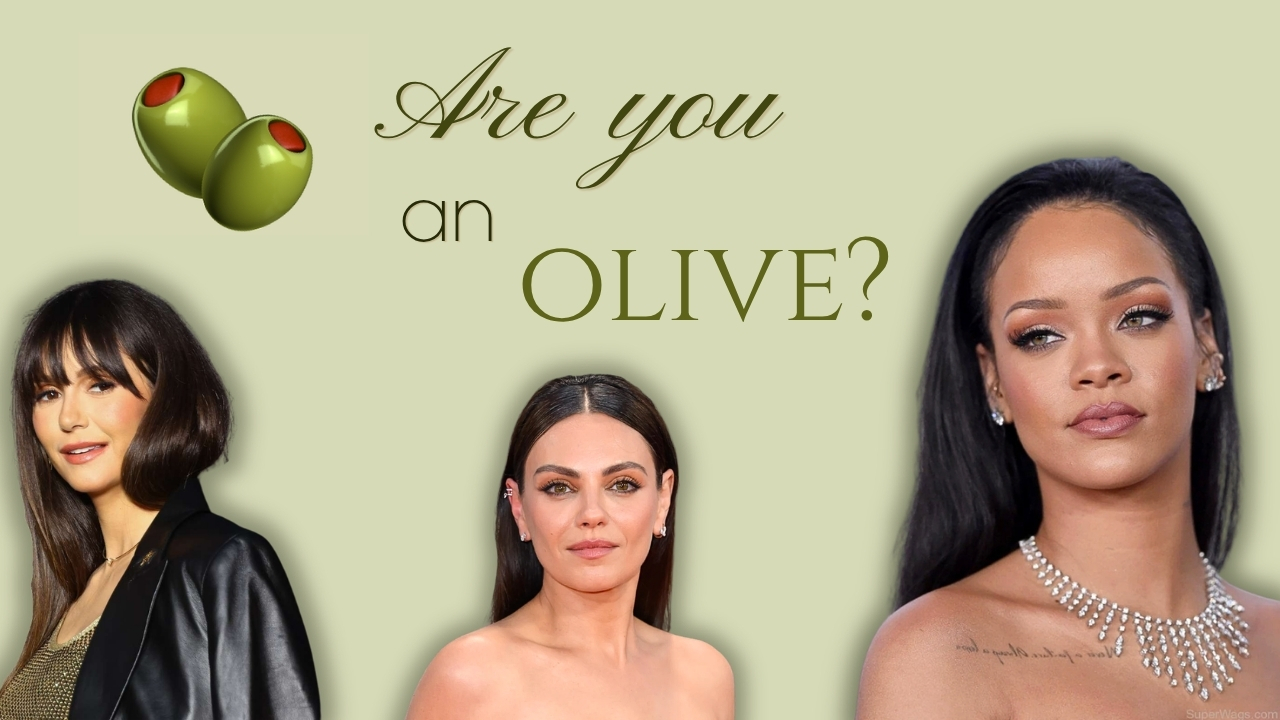
Olive undertones are remarkably common — far more common than the beauty industry's shade ranges suggest. They appear across every skin depth and ethnicity, though they are particularly prevalent in people of:
- Mediterranean descent — Greek, Italian, Turkish, Lebanese, Spanish
- Middle Eastern descent — Iranian, Iraqi, Syrian, Egyptian
- South Asian descent — Indian, Pakistani, Sri Lankan, Bangladeshi
- East Asian descent — Chinese, Japanese, Korean, Filipino
- Latin American descent — particularly those with Indigenous and Mediterranean heritage
- North African descent — Moroccan, Tunisian, Algerian
But olive undertones are not limited to these groups. Fair-skinned people of Northern European descent can have olive undertones. Deep-skinned people of West African descent can have olive undertones. Olive is about the greenish cast in your skin, not your skin depth or ethnicity.
How to Tell If You Actually Have Olive Undertones
The standard vein test (green veins = warm, blue veins = cool) does not work well for olive skin because olive people often see both green and blue veins, or veins that look teal or gray-green — which leads them to incorrectly identify as neutral. Here are the tests that actually work:
Every foundation you try looks either orange, pink, or unnaturally bright on your skin — even "neutral" shades. This is the most reliable diagnostic. If you have tried dozens of foundations across warm, cool, and neutral and NONE of them disappear into your skin, you almost certainly have olive undertones. The brightness issue is the dead giveaway — standard foundations have higher chroma than olive skin needs.
Stand in natural light wearing a plain white t-shirt. Look at your face and neck against the white fabric. If your skin looks distinctly greenish, grayish, or muddy against the white — rather than clearly pink (cool) or golden (warm) — you have olive undertones. Warm skin looks golden against white. Cool skin looks rosy. Olive skin looks muted and slightly green.
Look at the skin on the inside of your wrist in natural daylight. If it has a distinctly greenish, yellow-green, or gray-green quality — rather than clearly pink or golden — that is an olive indicator. Some olive people describe their inner wrist as looking "dirty" or "muddy" compared to warm or cool-toned friends.
Saturated colors look "off" on olive skin. Try a bright coral blush, a vivid orange lipstick, or a hot pink — if these colors look unnaturally intense, almost neon against your skin, it is because your low-chroma skin amplifies high-chroma pigments by contrast. On warm or cool skin, these colors just look warm or cool. On olive skin, they look like they belong to someone else's face.
Standard jewelry test says gold = warm, silver = cool. For olive skin: if BOTH gold and silver look fine but neither looks amazing — or if rose gold flatters you more than either — you may be olive. Warm olives lean toward gold. Cool olives lean toward silver. But neither metal has the dramatic "yes, this is clearly my metal" effect that warm and cool skin types experience.
Press the tip of your finger firmly for two seconds, then release. Watch the color return to your nail bed. On warm skin, it returns to a peachy-pink. On cool skin, a blue-pink. On olive skin, the nail bed often has a distinctly gray, mauve-gray, or brownish-gray quality rather than a clear pink. Some olive people describe their natural nail beds as looking "dusty" or slightly purple-brown.
If three or more of these tests resonate with your experience, you almost certainly have olive undertones. The next step is figuring out your olive subtype — warm, cool, or neutral — because that determines which specific foundation shades will work for you.
Warm Olive vs Cool Olive vs Neutral Olive: How to Tell the Difference
This is where it gets nuanced. All olives share the green-muted quality, but the underlying warm-cool lean determines which direction your foundation shade needs to pull.
There is one more dimension the Reddit r/OliveMUA community identifies: muted olive vs bright olive. Most olives are muted — their coloring has a gray, soft quality that makes bright colors look jarring. But some olives are "bright" — they have a more pronounced green hue and can handle more saturated shades without the clashing effect. If pure, vivid jewel tones (emerald, sapphire, ruby) look amazing on you rather than overwhelming, you may be a bright olive. If those same colors look like they are wearing you instead of the other way around, you are a muted olive — and you need even more desaturated product choices.
Why Every Foundation Looks Wrong on Olive Skin
Understanding why foundations fail on olive skin is essential — it changes how you shop. There are four specific failure modes:
"Warm foundations should work on olive skin because olive is warm-leaning"
Warm foundations are designed for warm non-olive skin — they have HIGH chroma (saturated golden-yellow pigments). When placed on LOW chroma olive skin, the excess saturation has nowhere to go. It manifests as orange because your skin cannot absorb and integrate the intensity. The foundation looks like it is sitting on top of your face.
"Neutral foundations are the safe choice for olive skin"
Neutral foundations split the difference between warm and cool — but they still have normal chroma levels. On olive skin, neutral foundations often look unnaturally bright or "clean" because they lack the muted, desaturated quality that olive skin needs. The brightness mismatch is why your face looks like it belongs to a different body.
"If you mix a warm and cool foundation, you get an olive match"
Mixing warm and cool foundations gives you a neutral — but not an olive. You are adjusting the hue but not the chroma. To truly create an olive match from non-olive foundations, you need to add a green or blue mixer to DESATURATE the formula. This drops the chroma to match olive skin's natural mutedness.
"Olive skin only exists at medium depths — fair and deep skin cannot be olive"
Olive undertones exist at every skin depth. Fair olives may notice their skin looks grayish or sallow rather than obviously green. Deep olives may see the olive cast more clearly on their palms, inner arms, or when comparing their skin to non-olive people of the same depth. The green is there at every depth — it is just harder to see at the extremes.
The Chroma Problem Explained
This is the concept that changes everything for olive skin. In color theory, every color has three properties:
- 🎨 Hue — the color family (red, yellow, blue, green, etc.)
- 🌗 Value — how light or dark the color is
- 💎 Chroma — how saturated or muted the color is
The foundation industry formulates shades by adjusting hue (warm/cool/neutral) and value (light to deep). But they rarely adjust chroma — the saturation level. Most foundations have medium to high chroma because that makes the pigments look vibrant and "healthy" in the bottle. Olive skin, however, has inherently low chroma. When you put a medium-chroma foundation on low-chroma skin, the excess saturation creates a visible mismatch. The foundation looks too colorful, too clean, too bright — like an Instagram filter that has been applied only to your face.
This is why olive people often say a foundation "looked right in the bottle but wrong on my skin." The bottle color was close in hue and value, but the chroma was too high. And this is why olive people instinctively reach for foundations that look "too gray" or "too dull" in the bottle — those muted-looking shades actually match the chroma of olive skin.
There is a technical reason most foundations lack olive options. The standard foundation pigment system uses four iron oxide pigments: black, white, red, and yellow. These four pigments can produce the full range of warm, cool, and neutral shades — but they cannot produce olive. Creating truly olive shades requires adding a fifth pigment: Chromium Oxide Green. This green pigment adds the muted, desaturated, green-leaning quality that olive skin needs. A few brands have started doing this — Lancome uses Chromium Oxide Green in their Teint Idole Ultra Wear range, which is why certain shades in that line have an olive-friendly quality that other brands' shades lack. But most brands have not invested in this additional formulation complexity, which is why the olive gap persists.
Step-by-Step: How to Shade Match Foundation for Olive Skin
Here is the exact process to find your match. This is the system that actually works — not the "swatch three shades on your jaw" shortcut that fails everyone.
Step 1: Identify Your Olive Subtype
Use the tests above to determine if you are warm olive, cool olive, or neutral olive. This determines which shade families to start with.
Step 2: Know Your Depth
Olive exists at every depth. Identify yours:
- Fair olive — your skin is light but has a grayish-green quality rather than pink or peach
- Light-medium olive — classic "Mediterranean" coloring, golden-green or beige-green
- Medium olive — clearly olive-toned, may tan deeply in summer
- Medium-deep olive — rich olive tone, common in South Asian and Middle Eastern skin
- Deep olive — deep skin with an olive cast visible on palms, inner arms, and against non-olive comparisons
Step 3: Swatch in the Right Place
Never swatch foundation on your hand or inner wrist. Your hands are almost always a different depth and undertone than your face. Instead:
- Swatch along your jawline — apply a stripe from your jaw down onto your neck
- Use natural daylight — indoor lighting distorts undertone. Step outside or stand near a window
- Wait 15 minutes — this is critical for olive skin because foundation oxidation affects olive shades differently. Olive-friendly foundations may shift slightly greener as they settle, which actually improves the match. Standard foundations shift oranger, which makes them worse
- Check the match from a distance — step back from the mirror. A true match disappears into your skin at arm's length
Step 4: The Two-Shade Test
Here is a technique that professional MUAs use on set. Instead of trying to find one perfect shade, pick two close shades — one slightly warm, one slightly cool (or one slightly light, one slightly dark) — and blend them together on your jaw. This lets you custom-calibrate the hue and depth simultaneously. For olive skin, this is often more effective than trying to find a single perfect shade because most shade ranges are not formulated with olive chroma.
Step 5: The "Wrong in the Bottle" Rule
If a foundation shade looks slightly gray, slightly green, slightly "off," or slightly muddy in the bottle — try it. Shades that look unappealing in the bottle are often the ones that match olive skin because they have the low chroma that your skin needs. If it looks vibrant and beautiful in the bottle, it probably has too much chroma for olive skin.
The Best Foundations for Olive Skin — By Price Range
Not all shade ranges are created equal for olive skin. Some brands accidentally include olive-friendly shades. A few have started doing it intentionally. Here is the definitive list, organized by price range and olive subtype.
High-End Foundations
The gold standard for olive skin — and it is not a coincidence. Giorgio Armani is an Italian brand, and the shade range was developed with Mediterranean skin tones in mind. The formula has a naturally low-chroma, skin-like finish that does not amplify undertones the way many foundations do.
Best olive shades: Shade 4 (light warm olive), Shade 5 (light-medium neutral olive), Shade 5.5 (medium warm olive), Shade 6 (medium golden olive), Shade 6.5 (medium-deep olive). The .5 shades were specifically added to fill gaps between the original range — and many of them happen to be perfect for olive undertones.
Finish: Luminous satin. Medium coverage that builds. Wears 8-10 hours without oxidizing heavily.
Price: $69 (1 oz). Available at Sephora, Nordstrom, and Giorgio Armani Beauty. Shop product Mini available
NARS has one of the most olive-inclusive shade ranges in prestige beauty. The brand's founder, Francois Nars, is French-born with personal experience shade-matching diverse skin tones, and it shows in the formulation.
Best olive shades: Barcelona (light-medium warm olive — a cult favorite in the Reddit r/OliveMUA community), Syracuse (medium warm olive), Stromboli (medium-deep warm olive), Vanuatu (medium neutral olive). The "B" coded shades (Beige) tend to lean olive-friendly.
Finish: Natural radiant. Medium buildable coverage. The light-reflecting technology gives a "your skin but better" effect.
Price: $49 (1 oz). Available at Sephora, Nordstrom, NARS.com. Shop product
MAC's shade system is one of the most olive-aware in the industry. Their undertone coding — N (neutral), C (cool), W (warm), NC (neutral-cool), NW (neutral-warm) — gives you granular control. The N-coded shades are where olive people tend to find their match, particularly N4, N5, N6, and N6.5.
Best olive shades: NC25 (light-medium warm olive), NC30 (medium warm olive), N4 (light-medium neutral olive), N5 (medium neutral olive), NC42 (medium-deep warm olive). Note: MAC's NC and NW codes are famously counterintuitive — NC stands for "Neutral Cool" but actually runs warm. Confusing, but the shades themselves are excellent for olive skin.
Finish: Matte. Medium to full coverage. 24-hour wear. Best for oily and combination olive skin.
Price: $40 (1 oz). Available at MAC stores, Sephora, Ulta, Nordstrom. Shop product
This Japanese brand is a hidden gem for olive skin. The formulation uses mineral pigments with naturally low chroma — the colors look muted and "off" in the bottle, which is exactly what olive skin needs. Fair-skinned olive people who have been searching for years often find their match here.
Best olive shades: 113 (fair warm olive), 123 (fair-light olive), 143 (light-medium olive), 213 (medium olive). The brand runs slightly green across the range, which is a feature, not a bug, for olive undertones.
Finish: Dewy-natural. Sheer to medium coverage. Extremely hydrating — works beautifully on dry olive skin. See our foundation finishes guide for how finish affects wear and oxidation on every skin type.
Price: $62 (1 oz). Available from Koh Gen Do. Shop Koh Gen Do Mini available
Fenty Beauty is one of the few major brands that explicitly codes olive shades with an "O" designation in their numbering system — no guessing required. The shade range is extensive enough to cover olive at multiple depths.
Best olive shades: 290 O (medium warm olive), 330 O (medium-deep warm olive). The "O" code in the shade number tells you immediately that the shade is formulated for olive undertones.
Finish: Soft matte. Medium to full coverage. Long-wearing formula that resists oxidation well.
Price: $42 (1.08 oz). Available at Sephora, fentybeauty.com. Shop product
Dior uses a "WO" (Warm Olive) designation in their shade system — one of the clearest olive labeling approaches in prestige beauty. The Face & Body formula is lightweight and buildable with a natural finish that lets olive skin's complexity show through.
Best olive shades: 2WO (fair warm olive with ambery undertones), 3WO (light-medium warm olive). Sephora community reviewers describe 3WO as "a lovely balance of yellow and olive with just the right amount of depth."
Finish: Demi-matte natural. Light to medium buildable coverage. Waterproof formula.
Price: $40 (1.6 oz). Available at Sephora, Dior.com. Shop product
Mid-Range Foundations
ILIA's serum foundation has a naturally skin-like, low-chroma finish that works beautifully on olive undertones. The formulation is skincare-forward with niacinamide and hyaluronic acid — and the pigments are muted enough to avoid the "too bright" problem on olive skin.
Best olive shades: Corsica (light-medium warm olive), Kokkini (medium warm olive), Roque (medium neutral olive). ILIA shade names do not follow a numbered system, so you need to swatch or compare.
Finish: Dewy-natural. Light to medium coverage. Best for normal to dry olive skin.
Price: $54 (1 oz). Available at Sephora, iliabeauty.com. Shop product
Danessa Myricks is one of the few brand founders who openly discusses olive undertones in shade development. Her Yummy Skin Serum Skin Tint is a skin-like, buildable base with a naturally low-chroma finish — and the shade range includes olive-leaning options that other brands miss.
Best olive shades: the mid-range "N" and "W" coded tints lean olive-friendly. Swatch along the jaw to land between two depths. The brand also makes Prism FX color adjusters — including a green adjuster specifically for olive correction.
Finish: Skin-like, dewy-natural. Sheer to medium buildable coverage. Skincare-forward formula with peptides and ceramides.
Price: $39 (1 oz). Available at Sephora, danessamyricks.com. Shop product
Drugstore Foundations
The Fit Me range has a handful of shades that accidentally lean olive — specifically the ones that most people skip because they look "weird" or "too yellow-green" in the tube. This is your budget olive hero.
Best olive shades: 220 Natural Beige (light-medium warm olive), 228 Soft Tan (medium warm olive), 230 Natural Buff (medium neutral olive), 310 Sun Beige (medium-deep warm olive). Shade 228 in particular is a cult favorite in olive skin communities.
Finish: Matte. Medium coverage. Works best on oily and combination skin.
Price: $9 (1 oz). Available at drugstores, Target, Walmart. Shop product
L'Oreal True Match uses a warm-cool-neutral system similar to MAC, and the neutral shades can work for some olive undertones. The formula is forgiving and blendable, making it easier to mix shades if you fall between two options.
Best olive shades: W4 Natural Beige (light-medium warm olive), W5 Sand Beige (medium warm olive), N5 True Beige (medium neutral olive), W6 Sun Beige (medium-deep warm olive). The "W" shades lean slightly less saturated than most warm drugstore foundations.
Finish: Natural satin. Medium coverage. Lightweight and comfortable for all-day wear.
Price: $12 (1 oz). Available at drugstores, Target, Walmart. Shop product
L'Oreal Infallible Fresh Wear does not have dedicated olive shades, but its wide neutral-beige range gets close enough to work with a green mixer. Pair a close-ish shade with one drop of a green foundation adjuster and you have a custom olive match. This is the most affordable entry point into the mixer technique, and the full-coverage matte formula holds the mixed pigment well.
Best olive shades (before mixing): 130 True Beige, 220 Sand, 245 Radiant Honey. These neutral-warm shades are close enough to olive that one drop of the green mixer closes the gap.
Finish: Matte, longwear. Full coverage. Up to 24-hour wear. Best for oily and combination skin.
Price: $18 (1 oz). Green mixer: $7. Available at drugstores, Ulta, lorealparisusa.com. Shop product
The Foundation Mixer Hack: Turn Any Foundation Olive
This is the technique that changed the game for olive skin. If you cannot find a foundation with the right olive chroma, you can create it by adding a color adjuster to any close-match foundation. This is what professional MUAs have been doing on set for decades, and it is now accessible to everyone at drugstore prices.
How Foundation Mixers Work
Color mixers (also called adjusters or drops) are concentrated pigments designed to shift a foundation's undertone or depth. For olive skin, you need green or blue mixers:
- Green mixer — directly adds the green quality that olive skin has naturally. This is the most straightforward fix. One to two drops per pump of foundation is usually enough.
- Blue mixer — counteracts the orange-warm excess in foundations by cooling and desaturating the formula. Blue is the complementary color of orange, so it neutralizes the warmth that makes foundations look wrong on olive skin. This works especially well for cool olives.
The Mixing Technique (Step by Step)
- Pump your foundation onto the back of your hand (or a mixing palette)
- Add ONE drop of your chosen mixer. Start with less — you can always add more
- Mix thoroughly with a spatula, brush, or your finger until the color is completely uniform
- Check the color — it should look slightly muted, slightly green or gray compared to the original. If it still looks too bright, add another drop
- Apply as normal — the mixed formula applies and wears exactly like regular foundation
- Adjust ratio each time — your skin's appearance changes with seasons, lighting, and tan levels. You may need more mixer in winter (when your skin is lighter and the olive cast is more visible) and less in summer (when a tan adds warmth)
Best Foundation Mixers for Olive Skin
Use BLUE if your main problem is that foundations look too orange or too warm. Blue is the complement of orange — it neutralizes warmth and drops chroma simultaneously. Best for cool olives and neutral olives.
Use GREEN if your main problem is that foundations look too pink, too bright, or too saturated. Green directly matches the olive quality in your skin. Best for warm olives.
Color Correcting for Olive Skin
Color correcting follows different rules on olive skin. The dark circles under olive eyes are not the typical blue-purple that most people have — they often have a brown, greenish-brown, or gray-brown quality because the olive pigmentation extends to the under-eye area. This means standard peach or orange correctors (designed for blue-purple circles) may not work as well.
Under-Eye Color Correcting for Olive Skin
If your dark circles are brown or greenish-brown: Use a peach or salmon corrector, but choose a muted, desaturated version rather than a bright, vibrant one. Bright peach on olive under-eyes can look unnaturally vivid. The Smashbox X Becca Under Eye Brightening Corrector in its medium-deep shade has the right muted quality.
If your dark circles are gray or blue-gray: Use an orange corrector for medium to deep olive skin, or a bisque/warm-beige corrector for light to medium olive skin. The LA Girl Pro Conceal in Orange or Peach works well here.
If your dark circles are purple: Standard peach and orange correctors work, but go one shade more muted than guides recommend for non-olive skin. The olive quality in your skin will amplify any corrector pigment.
For redness and acne on olive skin: Here is where olive skin breaks the standard rules. Most color correcting guides say "use a green corrector for redness." But olive skin already has green in it — adding more green on top can make you look gray or sickly. Instead, use a yellow corrector for redness on olive skin. Yellow neutralizes the purple-red of inflammation without adding to the green cast that is already there.
For sallowness or dullness: Olive skin can look sallow or grayish, especially in winter. A lavender primer or corrector can brighten olive skin without adding warmth — it counteracts the yellow-green cast just enough to make skin look fresh and awake.
The application rule for olive skin: Always sheer out your corrector more than you think you need to. Olive skin amplifies color — a thin, diffused layer of corrector does more work on olive skin than a thick layer does on non-olive skin.
Beyond Foundation: Complete Color Guide for Olive Skin
Foundation is just the beginning. Once you understand that olive skin has low chroma, the rules for every other color product become clear: choose muted, desaturated versions of colors rather than bright, saturated ones.
Blush for Olive Skin
Bright blush on olive skin looks like a mistake — it reads as unnaturally vivid because your low-chroma skin makes high-chroma pigments pop by contrast. The fix is to reach for dusty, muted, or "dirty" looking blushes that most people skip. Warm olives do best with soft terracotta and dusty peach, cool olives with dusty rose and muted berry, and neutral olives with dusty mauve-pink and soft taupe-rose.
We put together a complete guide to blush for olive skin with full product picks from drugstore to prestige, video swatches, and shade recommendations by olive subtype.
Bronzer for Olive Skin
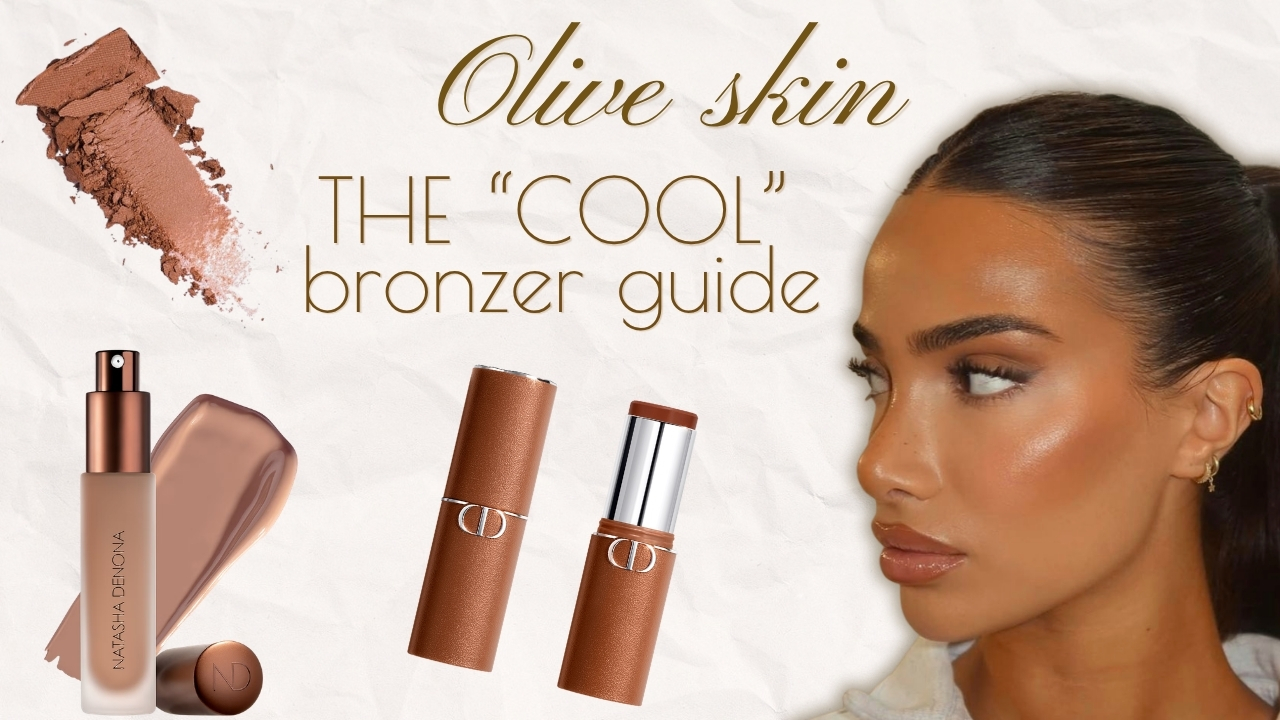
Most bronzers are formulated with warm, saturated pigments that overwhelm olive skin's muted quality — the bronzer looks like an orange stripe instead of a sun-kissed glow. The counterintuitive fix: choose bronzers that lean cool or neutral, not warm.
For our full breakdown with product picks, application tips, and recommendations by olive subtype, see our complete bronzer guide for olive skin. Our contouring tutorial covers placement for every face shape.
Lipstick for Olive Skin
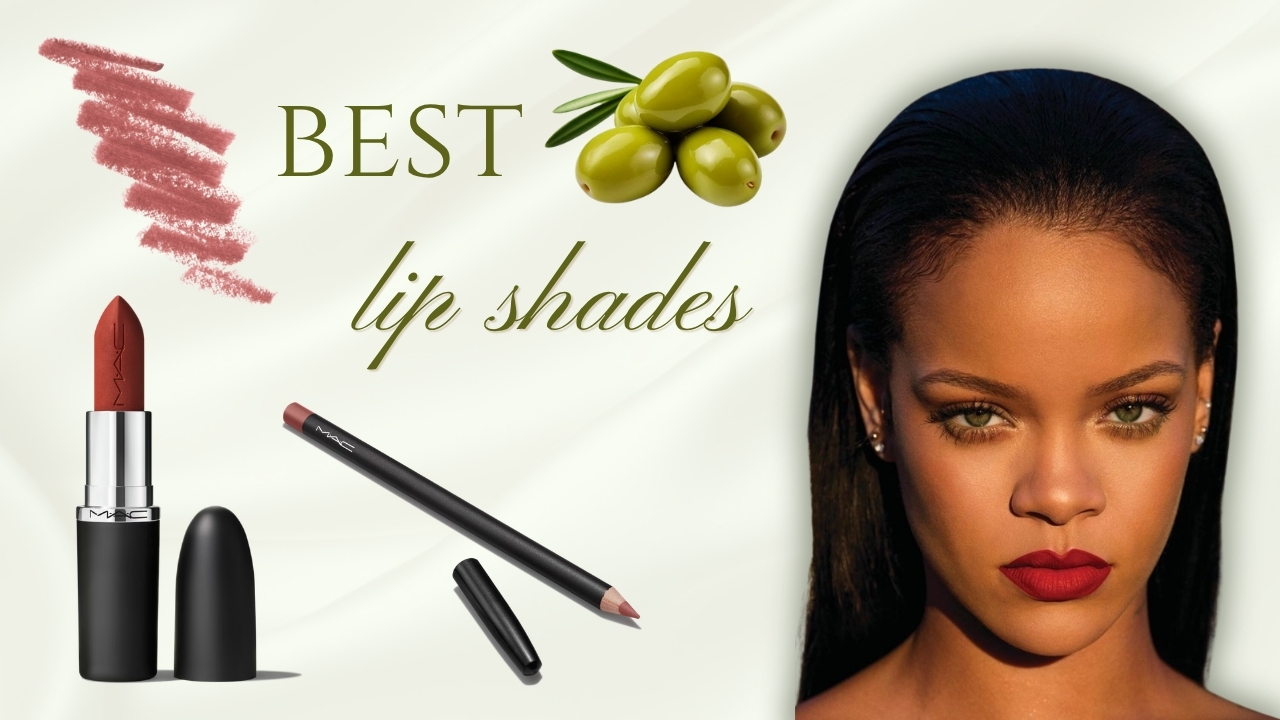
Olive skin has a superpower when it comes to lipstick: muted lip shades that look "off" on other people come alive on olive skin. Dusty mauves, brownish roses, muted berries, and terracotta nudes find their natural home on olive undertones.
Our complete lip guide for olive skin covers the best shades by olive subtype (warm, cool, neutral), bold lip strategies, and what to avoid — with video swatches and product picks.
Eyeshadow for Olive Skin
Olive eyes often have a warm, golden-green or hazel quality that pairs beautifully with specific shadow families:
Colors that work: Warm browns, bronzes, coppers, burnt orange (muted, not neon), olive green, khaki, taupe, dusty purple, burgundy, mauve, champagne gold. Earth tones and jewel tones in muted formulations are olive skin's sweet spot.
Colors to modify: Blue eyeshadow can look beautiful on olive skin if it is a muted, smoky blue rather than a vivid cobalt. Teal is an especially flattering shade for olive eyes because it harmonizes with the green already in the skin.
Colors to approach carefully: Bright yellow, neon pink, vivid orange, bright white shimmer. These high-chroma shades create the same "too vivid" effect that bright blush does — they look like they are fighting your skin instead of complementing it.
Olive Skin by Season: How Your Match Changes
Olive skin shifts more dramatically with the seasons than most other undertones, and understanding this prevents you from buying a new foundation every time the weather changes.
Summer / Tanned Olive: When you tan, your skin gets deeper AND warmer — the warmth of the tan temporarily masks some of the green cast. You may find that standard warm foundations work better in summer than they do in winter. You will need less mixer, and your shade depth will increase by one to two levels.
Winter / Untanned Olive: When your tan fades, the olive cast becomes more prominent because there is less warm melanin masking it. This is when foundations look the most wrong — everything seems too warm, too pink, or too bright. You will need more mixer, and your shade depth will drop back down. Winter is also when the "sallow" or "grayish" quality of olive skin becomes most visible.
The solution: Rather than buying two separate foundations for summer and winter, buy one foundation in your lightest (winter) shade and one in your deepest (summer) shade. Mix them in different ratios throughout the year, adjusting the mixer drops accordingly. This gives you infinite custom shades from just two bottles.
Common Mistakes to Avoid on Olive Skin
After years of watching olive-skinned people struggle with foundation, these are the patterns that come up again and again. If you have made any of these mistakes, you are not alone — the system was not set up for you to succeed.
- Trusting beauty counter shade matching. Most beauty counter associates are trained on the warm-cool-neutral system. They do not know what olive is. They will match you to the least-offensive shade in a three-option system that does not include your undertone. If the associate does not mention olive or green or chroma, they are not matching you correctly.
- Giving up after three brands. It took the olive skin community years to crowdsource which specific shades in which specific brands actually work. The answer is usually one to two shades per brand, buried in a 40-shade range. Use the recommendations above to narrow your search.
- Matching in artificial light. Olive undertones are nearly invisible under fluorescent or warm tungsten lighting. They only become clearly visible in natural daylight. Always do your final shade check outdoors or by a north-facing window.
- Buying foundations that look "pretty" in the bottle. If it looks vibrant, golden, and beautiful in the bottle, it has high chroma and will look wrong on your low-chroma skin. Train yourself to reach for the shades that look "ugly" or "dull" — those are your shades.
- Skipping the mixer. A $7 blue or green mixer is the single most cost-effective olive skin purchase you can make. It turns any close-match foundation into a true match. Stop searching for the perfect shade and start creating it.
- Assuming your depth is the problem. When a foundation looks wrong on olive skin, people instinctively go lighter or darker — but the issue is almost always chroma, not depth. A foundation that is the right depth but wrong chroma will always look worse than one that is slightly off on depth but right on chroma.
Your Complete Olive Skin Routine — Step by Step
Here is the full application order for a flawless olive skin base, from skincare to setting:
1. Skincare prep. Cleanse, hydrate, SPF. Wait 10-15 minutes for sunscreen to absorb. (Our foundation shade testing guide covers prep in detail.)
2. Primer. Use a hydrating or blurring primer — not a color-correcting one. Green primers are designed for redness, not olive undertones, and they add a surface-level green that looks chalky rather than skin-like.
3. Color correct (if needed). Apply corrector to dark circles and any hyperpigmentation using the olive-specific corrector guidance above. Sheer it out more than you think.
4. Foundation. Mix your foundation with your blue or green adjuster on the back of your hand. Apply with a damp beauty sponge for the most skin-like finish on olive skin — sponges press product into the skin rather than sitting it on top, which is important for achieving the low-chroma, seamless look olive skin needs.
5. Concealer. One to two shades lighter than your olive-matched foundation, in the same undertone. Apply under eyes and on any remaining visible spots. Blend with a damp sponge. Our concealer vs foundation guide explains why the shade rules differ for under-eye brightening versus blemish concealing.
6. Set. Use a finely milled translucent powder — but be careful here. A stark white or cool-toned translucent powder can create a visible gray cast on olive foundation, undoing your carefully calibrated match. The Laura Mercier Translucent Loose Setting Powder (Mini available) works on all olive subtypes because it is truly color-neutral. Avoid any setting powder with a pink or white cast — if you notice ashiness after powdering, switch to a powder with a very slight warm tint or use a finely milled pressed powder that matches your foundation shade.
7. Bronzer, blush, highlight. Follow the olive-specific shade guidance above. Apply bronzer where the sun would naturally hit. Blush on the apples of the cheeks. Highlight on the high points — choose a champagne or soft gold highlighter rather than a bright white or silver, which can look ashy on olive skin. Our highlighting guide covers placement for every face shape.
Olive Skin Creators to Follow
If you want to keep learning about olive undertone makeup, these content creators are olive-skinned themselves and regularly share shade recommendations, swatches, and product reviews specifically for olive undertones:
What to Do Next
If you are new to olive skin matching, here is the action plan:
🔍 Confirm your olive subtype using the diagnostic tests above
🧴 Try one foundation from the recommendations in your depth and subtype
🎨 Buy a mixer — the LA Girl Pro Color Foundation Mixing Pigmentin Blue ($7) is the most popular starting point
☀️ Swatch in natural light, wait 15 minutes, check from a distance
💬 Visit the Reddit r/OliveMUA community for crowdsourced shade matches in specific brands — the community has compiled olive shade matches for hundreds of foundations. If you are fair-skinned and olive, also check Reddit r/FairOlives — a companion subreddit specifically for the light-skinned olive population that is particularly underserved by the beauty industry
If you are still building your undertone knowledge, start with our how to find your skin undertone guide, then read warm vs cool vs neutral undertone makeup for a full breakdown of how undertone affects every product beyond foundation. If foundation oxidation is also a problem for you, our oxidation guide explains why it happens and how to prevent it.
Use our Shade Matcher tool to search foundation shade databases by undertone and depth — the disclaimer in the FAQ explains that olive shades may not be accurately represented in all brand databases, so use the shade matches as starting points and refine with the mixer technique.
Test Your Olive Skin Knowledge
5 questions. How well do you really understand olive undertones?