The difference between a face that looks lifted, balanced, and intentional versus one that looks slightly off almost always comes down to the brows. Not the foundation shade. Not the lip color. The brows. They are the architecture of your face, and architecture that does not match the building looks wrong, no matter how beautiful the materials. This guide will teach you every eyebrow shape that exists, show you which ones work for your face, and walk you through how to create them yourself.
The Anatomy of an Eyebrow
Before we talk about shapes, you need to understand the parts. Every eyebrow has four sections, and each one plays a role in the overall shape.
The head is the inner end closest to your nose. It sets the starting width and determines how close-set or wide-set your brows appear. The body is the thickest horizontal section running along the brow bone. The arch is the highest point — the peak that creates lift and expression. And the tail is the tapered outer end that determines whether your brow lifts, drops, or extends past the eye. When a makeup artist says "your arch is too far forward" or "your tail drops too low," this is the language they are using. Understanding these four landmarks makes everything that follows click into place.
Your natural brow bone structure and hair growth pattern set the foundation. Smart shaping works with that foundation, not against it. The best eyebrow shape for you is always a refinement of what you were born with, not a total reinvention.
Every Eyebrow Shape Explained
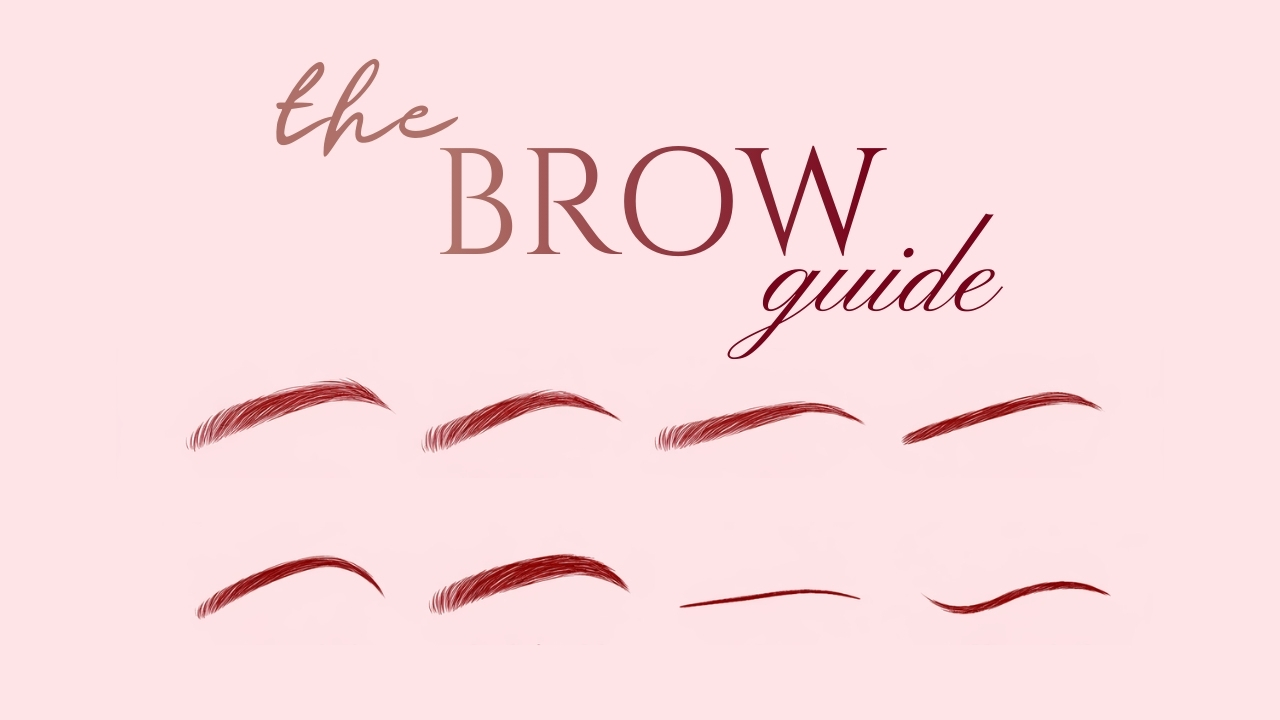
There are fourteen distinct eyebrow shapes you will encounter, from classic foundations to modern trends. Here is what each one looks like and who it flatters.
Soft Arch — A gentle, barely-there curve with the peak positioned above the outer edge of the iris. This is the most universally flattering shape because it adds subtle lift without drama. It works on almost every face shape and is the default recommendation when someone says, "Just make them look natural."
High Arch — A dramatic, pronounced peak that sits higher on the brow bone. This creates a lifted, wide-eyed look that draws attention upward. High arches work beautifully on round and full faces because the vertical emphasis elongates the face. On long or narrow faces, they can make the face appear even longer.
Low Arch — A minimal rise that stays close to a straight line with just the slightest curve. This is the most relaxed, approachable shape. Low arches suit oblong and long faces because the horizontal emphasis creates the illusion of width.
Straight — Minimal to no arch at all. The brow runs horizontally across the brow bone with an even thickness. This is the signature Korean brow shape and it creates a youthful, innocent look. Straight brows shorten long faces and soften angular jawlines.
Soft Angled — A balance between curved and angular. The brow rises gradually toward a subtle peak, then descends at a gentle angle. Think of it as the middle ground between a soft arch and a hard angle — structured enough to define the face, soft enough to avoid severity.
Hard Angled — A sharp, deliberate peak that creates a strong angular line. This is the "power brow" shape often seen in editorial beauty and high-fashion photography. Hard angles add intensity and structure, making them ideal for round or soft-featured faces that need definition.
S-Shaped — A rare and distinctive shape where the brow dips slightly near the head before rising to the arch, creating a gentle S-curve. Some people have this naturally and it is striking. If you do not have it naturally, it is very difficult to create and even harder to maintain.
Rounded — A continuous soft curve from head to tail with no visible peak or angle. Rounded brows are the best choice for square or angular faces because they counterbalance sharp jawlines and strong bone structure with softness.
Thick / Bold — Full-bodied, dense brows with minimal cleanup. This is less about the shape of the arch and more about the volume. Bold brows frame the face powerfully and are the dominant trend in 2026, continuing the move away from the over-plucked styles of the 1990s and early 2000s.
Thin — A narrow brow line with less hair density, either natural or tweezed down. Thin brows were iconic in the 1990s but can age the face and are difficult to grow back once over-plucked. If you have naturally thin brows, filling them in with a fine pencil creates the illusion of thickness without changing the shape.
Feathered — Brushed-up, textured brows where individual hairs are visible and intentionally unruly. This is the "brow lamination" look done at home with a strong hold gel — Refy Brow Sculpt is the product that made this look go viral, and it remains the gold standard for achieving feathered brows without a salon visit. Feathered brows are one of the biggest trends right now because they look both natural and groomed.
Tapered — Thick at the head and gradually narrowing to a fine point at the tail. This is one of the most classic and timeless shapes. A well-tapered brow looks polished in every setting, from boardrooms to beaches.
Fox Brow — The tail lifts upward instead of following the natural downward slope, creating a feline, elongated effect. This editorial shape gained popularity through social media and works best in photographic and creative settings. For everyday wear, a subtle version of the fox brow — where the tail just avoids dropping — is more wearable.
Laminated — Brows brushed straight up and set with a chemical or gel treatment to create a glossy, uniform texture. Brow lamination is a salon service that lasts 4-6 weeks, but you can mimic the look daily with the Refy Brow Sculpt (the product that launched with a 100K-person waitlist and effectively invented the at-home lamination category), the Anastasia Beverly Hills Brow Freeze for extreme hold, or the Rare Beauty Brow Harmony Flexible Lifting Gel for a softer, more flexible hold that never gets crunchy.
How To Determine Your Face Shape
Finding the best eyebrow shape starts with identifying your face shape. Here is the method I use with every client. Stand in front of a mirror, pull your hair completely back, and look at three things: the widest part of your face, the shape of your jawline, and the overall length versus width.
Oval — Your face is slightly longer than it is wide. The forehead is a bit wider than the chin, and the jawline is gently rounded. This is considered the most balanced face shape.
Round — Width and length are nearly equal. Cheeks are full, the chin is rounded, and the face lacks strong angles. The widest point is at the cheekbones.
Square — A strong, angular jawline with a forehead that is approximately the same width as the jaw. The face appears roughly as wide as it is long, but with angular rather than rounded features.
Heart — A wider forehead that narrows to a pointed or narrow chin. Cheekbones are prominent. Think of an inverted triangle.
Oblong / Long — The face is noticeably longer than it is wide, with a long straight cheek line. The forehead, cheekbones, and jawline are roughly the same width.
Diamond — Narrow forehead and chin with wide, prominent cheekbones. The cheekbones are clearly the widest part of the face.
Triangle / Pear — The jawline is wider than the forehead, creating an inverted pyramid. The chin area is strong and prominent.
Stand 12 inches from a mirror. Use a dry-erase marker or lipstick to trace the outline of your face directly on the mirror. Step back and look at the shape you drew. This is the fastest way to see your face shape objectively.
Use a soft tape measure. Measure across your cheekbones, forehead, jawline, and from hairline to chin. The largest measurement tells you your widest point. Compare length to width — if length is 1.5x the width, you are long/oblong. If roughly equal, you are round or square.
Your jawline is the deciding factor between face shapes that share similar proportions. A rounded jaw leans toward oval or round. An angular jaw means square. A pointed chin signals heart. A wide jaw with a narrow forehead means triangle/pear.
The Best Eyebrow Shape for Every Face Shape
This is the section most people came here for. I am going to give you the same advice I give clients who sit in my chair — which eyebrow shapes to try, and which to avoid, based on your bone structure.
Oval Face — You have the most freedom. Soft arch, tapered, and feathered shapes all work beautifully. Oval faces are balanced enough that most brow shapes complement them. The only shapes to be cautious with are very high arches or very hard angles, which can make an oval face look longer than it is.
Round Face — Your goal is to add vertical lines that elongate. Go for high arches, soft angled shapes, or hard angled shapes. The peak of the arch creates a visual lift that counteracts the roundness. Avoid rounded brows or flat/straight shapes — they will make your face look wider and rounder.
Square Face — Your goal is to soften the angles. Rounded brows, soft arches, and curved shapes balance a strong jawline. The softness of the brow contrasts with the sharpness of your bone structure in a flattering way. Avoid angular or hard-angled brows — they will amplify the squareness.
Heart Face — Your goal is to balance the wider forehead with the narrow chin. Soft rounded shapes and low-to-medium arches work best. Keep the brow length moderate — very long tails draw attention outward and make the forehead appear even wider. Avoid very high arches or dramatically angled shapes.
Oblong / Long Face — Your goal is to create horizontal width. Straight brows, low arches, and flat shapes visually shorten the face by creating a strong horizontal line. Extended tails add even more width. Avoid high arches — they add more vertical length to an already long face.
Diamond Face — Your goal is to soften the prominent cheekbones and add balance to the narrow forehead. Softly curved shapes, gentle arches, and rounded brows all work. Avoid overly arched or angular shapes that draw attention to the widest point of the face.
Triangle / Pear Face — Your goal is to add visual width to the upper face to balance the wider jawline. Longer brows with a subtle arch work well. Extended tails help create width at the top. Avoid very short brows or flat shapes that will not balance the strong jaw.
"Everyone should follow the golden ratio for perfect brow placement."
Tap to revealThe golden ratio is a useful starting point, but faces are not symmetric. Your brow placement should account for your unique bone structure, eye spacing, and natural growth pattern — not a universal formula.
"Brow shape affects how old you look more than most other makeup choices."
Tap to revealStudies show that eyebrow position and shape significantly influence perceived age. Higher, well-groomed brows create a lifted appearance that reads as younger, while drooping or thinning brows can add years.
"Round faces should always have round brows to match."
Tap to revealThe opposite is true. Round faces benefit from angular or arched brows that add contrast and vertical emphasis. Matching round brows to a round face amplifies the roundness rather than balancing it.
"Over-plucked brows from the 90s can always grow back fully."
Tap to revealYears of repeated plucking can permanently damage hair follicles. Some hairs may never return. Castor oil and growth serums can help, but if follicles are scarred or dormant for too long, microblading or brow pencils may be the only solution.
Eyebrow Mapping: Find Your Start, Arch, and End
Brow mapping is the technique professionals use to determine exactly where your eyebrow should start, where the arch should peak, and where the tail should end. The modern version of this method was pioneered by Anastasia Soare — the founder of Anastasia Beverly Hills — who applied the Golden Ratio from Renaissance art and architecture to the human face. Her three-point system became the industry standard, and every brow artist working today uses some variation of it. You can do this at home with a straight-handled makeup brush or a pencil.
Step 1 — Find the Start. Hold the brush vertically against the side of your nose, straight up past the inner corner of your eye. Where the brush crosses your brow bone is where the head of your eyebrow should begin. Mark it with a small dot of concealer or brow pencil.
Step 2 — Find the Arch. Angle the brush from the side of your nose through the center of your iris (looking straight ahead). Where it crosses the brow bone is your ideal arch placement. This puts the peak slightly beyond the center of the eye, which is the most universally flattering position.
Step 3 — Find the End. Angle the brush from the side of your nose through the outer corner of your eye. Where it crosses the brow bone is where the tail should end. The tail should never drop below the level of the head — if it does, it creates a drooping effect that weighs down the face.
Step 4 — Connect. Use a brow pencil to lightly connect the three points with your desired shape. Step back from the mirror and evaluate. Your eyebrows are sisters, not twins — slight asymmetry is normal and even desirable.
The most common mistake I see is shaping one brow at a time without a plan for the other. Map both brows first, step back, compare them, and then start removing hair. This one habit will save you from most brow disasters.
How To Shape Your Eyebrows at Home
Once you know your target shape, you need a method to get there. Here are the four most common approaches, ranked by precision and pain level.
Tweezing — The most precise method for home use. You remove one hair at a time, which gives you complete control. The downside is time — a full shaping session takes 10-15 minutes. Invest in a quality pair of slant-tip tweezers like the Tweezerman Slant Tweezer — cheap tweezers grip poorly and lead to breakage. Always tweeze in the direction of hair growth, and work in natural daylight if possible. Magnifying mirrors are helpful but dangerous — they can make you over-tweeze because you see hairs that are invisible at normal distance.
Threading — A cotton thread is twisted and rolled across the skin to pull hairs from the follicle. Threading is extremely precise, faster than tweezing, and ideal for sensitive skin because no chemicals touch the face. It is the traditional method in South Asian and Middle Eastern beauty practices and has become widely available in Western salons. If you want a professional shaping, Benefit BrowBars — located inside Sephora, Ulta, and department stores in 59 countries — offer waxing, threading, tinting, and lamination services with licensed aestheticians who specialize in brow architecture. The downside of threading at home is that it is nearly impossible to do on yourself and requires a skilled practitioner.
Waxing — Warm or cold wax is applied around the brow area and removed quickly, pulling multiple hairs at once. Waxing is the fastest professional method and gives clean, defined edges. However, it removes a layer of skin along with the hair, which means you should avoid waxing if you use retinoids, have sunburned skin, or are on certain acne medications. Waxing is less precise than threading or tweezing — it removes entire areas at once, so there is less room for error.
Brow Lamination — A chemical treatment that restructures brow hairs to stay in a brushed-up, uniform direction. Lamination lasts 4-6 weeks and creates the full, feathered look that is dominating beauty trends. It does not remove hair — it repositions what you have. Lamination is a salon service and is not recommended for DIY unless you have professional training, as the chemicals can irritate the delicate eye area. For the laminated look without the commitment, the Refy Brow Sculpt and Anastasia Beverly Hills Brow Freeze both deliver salon-level lift and hold that washes out at the end of the day. If you are curious about what goes into the products used on your face, our guide to what clean beauty actually means breaks down the science behind cosmetic ingredients.
Best for: Detail work, stray hairs, maintaining a shape between salon visits.
Pain level: Mild — individual hairs cause brief pinching sensations that diminish with regular use.
Grow-back time: 2-4 weeks depending on your hair growth cycle.
Bottom line: The safest, most controlled method. Your primary tool for home brow maintenance.
Best for: Full brow shaping with crisp edges. Ideal for sensitive skin and those who use retinoids.
Pain level: Moderate — multiple hairs are removed at once. Most people find it tolerable.
Grow-back time: 3-5 weeks. Threading pulls hair from the root, so results last longer than shaving.
Bottom line: The gold standard for professional brow shaping. Find a skilled threader and you will never go back.
Best for: Removing large areas of fine hair quickly. Good for people with dense growth above or below the brow.
Pain level: Moderate to high — the ripping sensation is more intense but over quickly.
Caution: Avoid if you use retinoids, AHA/BHA exfoliants, or have recently sunburned. Wax removes a thin layer of skin and can cause tearing or irritation on sensitized skin.
Bottom line: Fast and effective but less precise. Best for cleanup areas, not detailed shaping near the arch.
The Right Product for Every Brow Shape
The product you use matters as much as the shape you choose. Different formulas create different effects, and matching the product to your goal makes all the difference. Here are my top three picks, followed by a full breakdown by category.
Fine-tipped pencils create the most natural, hair-like strokes. They are the best tool for filling in sparse areas without looking drawn-on.
Anastasia Beverly Hills Brow Wiz (Mini available) — The cult-classic that loyalists have repurchased for over a decade. Its ultra-fine tip is still unmatched for precise, hair-like strokes.
Benefit Precisely, My Brow Pencil (Mini available) — Equally excellent, with a 1.5mm waterproof tip that lasts 12 hours.
Anastasia Beverly Hills MicroStroke Brow Pen — A superfine triple-tip that draws the most realistic hair strokes you can get from a product. Microblading effect without the appointment.
NYX Micro Brow Pencil — An excellent drugstore alternative at a fraction of the price.
Gels and waxes add volume, set hairs in place, and create the feathered or laminated look. Clear gels hold shape without adding color. Tinted gels add fullness and color simultaneously.
Refy Brow Sculpt — In a class of its own. This wax-gel hybrid sold out its six-month supply in six weeks at launch and delivers 12-hour sweatproof hold that genuinely looks like a salon lamination.
Rare Beauty Brow Harmony Flexible Lifting Gel — The best option if you want lift without stiffness. Its water-based formula holds all day but stays flexible and never flakes.
Anastasia Beverly Hills Brow Freeze (Mini available) — The strongest clear wax on the market. Extreme, all-day-event hold.
Benefit Gimme Brow+ Volumizing Gel (Mini available) — My go-to tinted gel for adding instant volume. Tiny microfibers cling to brow hairs and fill sparse areas beautifully. The perfect 2-in-1: hold plus fill in a single step.
Charlotte Tilbury Legendary Brows — A tinted gel with a micro-precision brush that adds fullness, texture, and feathered definition. Strong hold with a water-resistant formula.
e.l.f. Wow Brow Gel — A fiber-infused wax-gel hybrid that fills and volumizes for under $6. The best budget tinted gel on the market.
Benefit 24-HR Brow Setter — The clear gel to reach for when you need invisible hold that lasts through anything.
Pomades deliver the most pigment and staying power. They fill sparse brows with precision and set to a long-wearing finish.
Anastasia Beverly Hills Dipbrow Pomade — The original full-pigment pomade that launched a generation of brow tutorials. Nothing fills sparse brows with more precision and staying power.
Powders create a softer, more diffused fill — best on thick brows that need color rather than structure. Apply with a stiff angled brush using short, light strokes. And if your angled brush is caked with old product, it will not perform — learn how to clean your makeup brushes properly to keep your tools in shape.
Mousses split the difference between a pomade and a powder — they apply as a lightweight cream and set to a natural matte finish.
Revlon ColorStay Brow Mousse — Buildable coverage that lasts all day.
If you want one kit that does everything, these systems bundle the essentials into a streamlined routine.
Refy 3-Stage Brow Collection — Bundles their Brow Sculpt, Brow Pomade, and Brow Pencil into a sculpt-shade-define routine that simplifies what used to be a ten-product process into three steps.
Maybelline Brow Ultra Slim — For everyday maintenance between professional shapings, this pencil is hard to beat. Thin enough for realistic hair strokes, long-wearing, and available everywhere.
Why Tinted Brow Gels Are the Ultimate 2-in-1
If I could only recommend one brow product to someone who wants to look polished in under thirty seconds, it would be a tinted brow gel. No other formula does two jobs this well in a single step — it sets your hairs in place and fills in sparse spots with color at the same time. You skip the pencil, skip the powder, skip the setting gel. One product, one swipe, done.
The secret is in the fibers. The best tinted gels are loaded with tiny hair-like fibers that cling to your existing brow hairs and to the skin between them, creating the illusion of density where there is none. The tint adds depth and dimension, while the gel base holds everything in the direction you brush it. The result looks more natural than pencil work because you are building on your real brows rather than drawing on top of them.
Benefit Gimme Brow+
The original fiber gel that started the category. Tiny microfibers cling to skin and hair for instant volume and fullness. Flexible hold, natural finish, 10 shades. Benefit Gimme Brow+ Volumizing Gel
Charlotte Tilbury Legendary Brows
A micro-precision brush delivers strong hold with feathered definition. Water-resistant, vitamin-enriched formula that lasts all day. The luxury pick. Charlotte Tilbury Legendary Brows
e.l.f. Wow Brow Gel
A fiber-infused wax-gel hybrid with Kaolin Clay that fills and volumizes brows for under $6. Buildable, vegan, cruelty-free. Proof that great brows do not require a luxury budget. e.l.f. Wow Brow Gel
For application, brush the gel upward through your brows starting from the head and working toward the tail. Build color gradually — one coat gives a natural wash of tint, two coats add visible density. If you over-apply, a clean spoolie run through the brows while the gel is still wet will remove excess and soften the look. Pair a tinted gel with a fine pencil only where you need extra definition — the arch peak and the tail are the two areas that benefit most from pencil precision on top of a gel base.
Eyebrow Shapes as You Age
Brows change with age, and the shape that worked in your twenties may not work in your fifties. Understanding these shifts helps you adapt gracefully.
In your 20s and 30s, brow hair is typically at its thickest and most responsive to shaping. This is when you can experiment freely — try the bold, thick looks trending now. Just avoid over-tweezing. The follicle damage you do in your twenties shows up in your forties.
In your 40s, you may notice the first signs of thinning, particularly at the tail. The brow may also begin to drop as skin loses elasticity. This is the time to start filling in sparse areas and to raise the arch slightly to compensate for the natural descent. Switch from plucking below the brow to plucking above, which lifts the brow visually.
In your 50s and beyond, gray or white brow hairs become common, and overall density continues to decrease. Use a tinted brow gel to add both color and volume — the Benefit Gimme Brow+ Volumizing Gel is ideal here because the fiber technology adds visible density to thinning brows without looking heavy. Choose a shade one step lighter than your natural color — going too dark looks harsh against aging skin. For filling, the Anastasia Beverly Hills Brow Wiz (Mini available) pencil creates the most natural hair-like strokes to disguise sparse patches. Consider brow tinting at a salon for color that lasts 3-4 weeks without daily application — Benefit BrowBars inside Sephora, Ulta, and department stores nationwide offer professional tinting and shaping services. The shape goal at this stage is soft, lifted, and full — avoid thin or highly angular shapes, which can look severe.
If you have dark hair, go one shade lighter for the brows. If you have light hair, go one shade darker. An exact match looks flat and unnatural because brow hair has a different texture than head hair.
Always brush brow hairs upward with a spoolie before applying any product. This reveals your natural shape, shows you exactly where the sparse spots are, and prevents over-application. You cannot fill what you cannot see.
If you want to change your brow shape significantly, stop all hair removal for 6-8 weeks first. Let everything grow in so you have maximum hair to work with. Use castor oil nightly on sparse areas to encourage growth. Then shape from the full canvas.
Long brow hairs that curl or droop are a common cause of messy-looking brows, especially for men and mature clients. Brush hairs straight up and trim anything that extends above your desired brow line with small scissors. This alone can transform unruly brows.
Eyebrow Shapes Around the World
Beauty standards for eyebrows vary dramatically across cultures, and understanding this context makes you a better, more inclusive beauty practitioner.
East Asian brow trends favor straight or softly curved shapes with minimal arch. Korean beauty in particular has popularized the straight brow as a symbol of youth and approachability. The emphasis is on soft, natural-looking fullness rather than dramatic sculpting.
South Asian and Middle Eastern traditions lean toward thick, defined brows with a pronounced arch. Threading originated in these cultures and remains the preferred shaping method. Bold, dark brows are considered a sign of beauty and expressiveness.
Western trends have cycled through extremes — from the pencil-thin brows of the 1920s and 1990s to the hyper-groomed Instagram brows of the 2010s to the natural, feathered look dominating 2026. The current Western trend is converging with the East Asian preference for fullness and softness, with less emphasis on sharp definition.
East Asian: Straight & Soft
Minimal arch, natural density, youthful effect. Achieved with light pencil strokes and clear brow gel. Emphasizes approachability over drama.
South Asian: Bold & Arched
Pronounced arch, thick density, defined edges. Maintained with threading. Emphasizes expressiveness and classic beauty.
Western: Feathered & Full
Brushed-up texture, visible individual hairs, laminated finish. Achieved with brow gel or salon lamination. Emphasizes natural beauty.
Common Eyebrow Shaping Mistakes
After fifteen years of fixing brow disasters, I can tell you the most common mistakes almost always come down to the same handful of errors.
Over-plucking from below. This is the number one mistake. People remove too much hair from beneath the arch, which makes brows look thin and surprised. Follow your natural shape — only remove obvious strays that fall below your brow bone, not hairs that contribute to the body of the brow.
Ignoring the tail. A tail that drops below the level of the head creates a permanent sad, drooping expression. Always check that your tail ends at or above the height where your head begins. If your natural tail drops, you can tweeze the lowest hairs and fill in with pencil at a slightly higher angle.
Making both brows identical. Your eyebrows are sisters, not twins. Forcing perfect symmetry usually means over-removing from one side to match the other. Work with the natural differences. Small asymmetries are invisible to everyone except you in a magnifying mirror.
Using a magnifying mirror exclusively. Magnification reveals hairs that are invisible at normal viewing distance. Shape in a magnifying mirror if you need to, but step back to a normal mirror frequently to check the overall balance. The face other people see is from five feet away, not five inches.
Choosing a shape that fights your natural growth pattern. If your hair grows in a straight horizontal pattern, forcing a high arch means constant maintenance and a perpetually "growing out" look. Work with your natural direction and density, not against it.
Frequently Asked Questions About Eyebrow Shapes
There is no single most attractive shape — it depends entirely on your face shape and features. Research consistently shows that well-groomed, proportionate brows are perceived as more attractive than any specific shape. A soft arch is the most universally flattering starting point because it adds subtle lift without dominating the face.
Brows with a slightly higher arch and fuller density tend to create a more youthful appearance. As we age, brows naturally thin and droop, so lifting the arch and filling in sparse areas reverses those visual cues. Avoid overly thin brows, which can add years to any face.
Stop all brow grooming for 6-8 weeks and let everything grow in. Your natural shape will reveal itself — the density, the arch position, and the growth direction. Once you see the full picture, you can decide how much to refine. Most people are surprised to find their natural shape is closer to their ideal than they expected.
High arched or angled shapes work best for round faces. The vertical emphasis created by a pronounced arch counteracts facial roundness and makes the face appear longer and more structured. Avoid rounded or flat brows, which will echo the circular shape of the face.
Yes, particularly in the East Asian beauty tradition where straight brows have been popular for years. In Western beauty, the trend is moving toward natural, feathered brows that may be straight or softly curved depending on your natural growth pattern. The overarching 2026 trend is authenticity — whatever shape looks natural on your face is in style.
Threading is more precise and gentler on the skin, making it the better choice for most people. It is especially preferred if you use retinoids or have sensitive skin. Waxing is faster and better for removing large areas of fine hair, but it is less precise and removes a thin layer of skin along with the hair.
Test Your Eyebrow Shape IQ
5 questions. How well do you really know your brows?
The Bottom Line: Your Brows, Your Rules
The best eyebrow shape is the one that makes you look in the mirror and feel like yourself — just a more polished, intentional version. Use the face-shape guide as a starting point, not a prison. Map your brows before you touch a tweezer. Work with your natural growth pattern instead of fighting it. And remember that trends come and go, but a well-shaped brow that suits your face is always in style.
Your brows frame every expression you will ever make. Take the time to get them right.