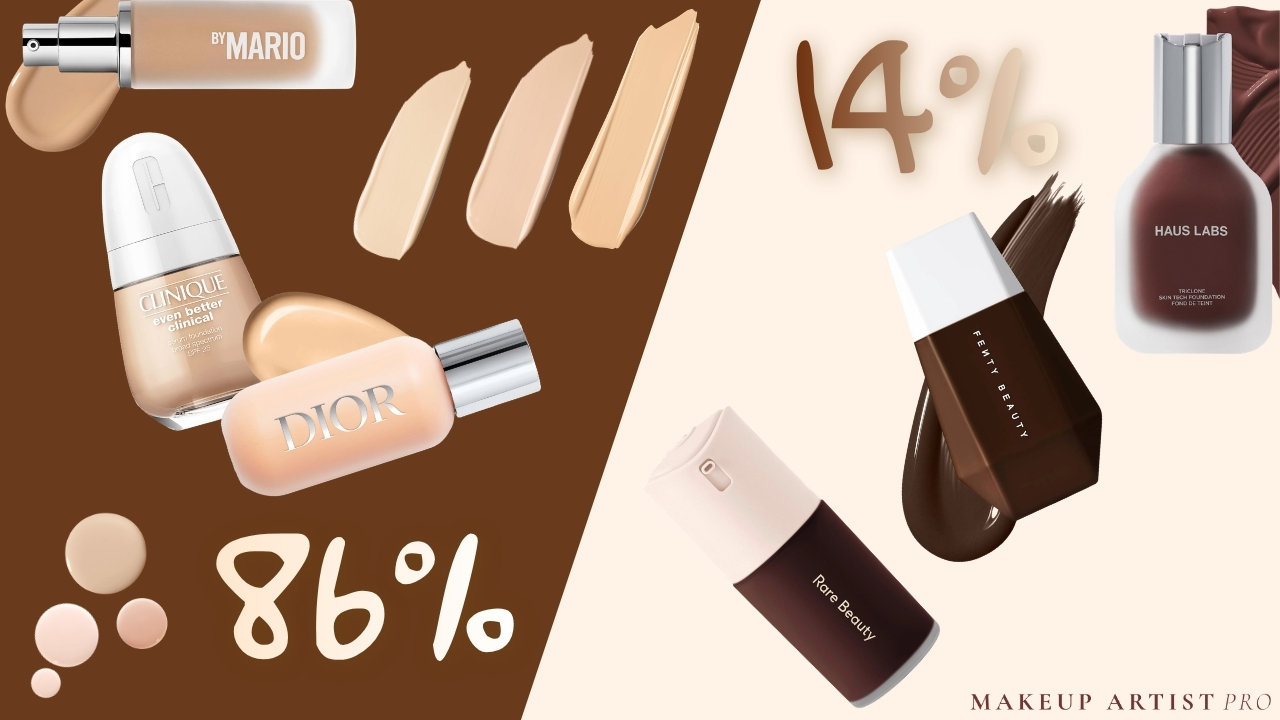
Every major foundation launch since 2017 has come wrapped in the same promise: a "wide" or "extended" or "all-inclusive" shade range. The marketing language is identical across DIOR, Charlotte Tilbury, Sephora Collection, and Anastasia Beverly Hills. So we did something almost nobody outside a brand's analytics team has done: we pulled the actual shade catalog from the major prestige retailers — every shade, every brand, every product — and counted what's really on the shelf.
The dataset: 3,369 foundation shades, 59 brands, every shade tagged with a numeric depth score from 1 (palest) to 10 (deepest). What we found is that the gap between marketing language and actual catalog depth is wider than the industry would like you to believe — and the brand many shoppers assume is the inclusivity benchmark isn't even close to the top.
How We Built the Dataset
Every shade in the analysis comes from a real product page on Sephora, Ulta, or the brand's official site. We pull the catalog continuously and cross-match shades across retailers so the same SKU isn't double-counted. Each shade is then placed on a 1-to-10 depth scale using its measured undertone and value — a consistent index, applied identically to every brand. This means a Fenty Pro Filt'r 498 and a NARS Sheer Glow Khartoum are graded on the same axis.
For this study we filtered to:
- Foundations only (no concealers, no powders, no body makeup)
- Brands with 20+ shades in the dataset (9 brands fall below this floor and are excluded from the brand-level rankings — the dataset is too thin to grade them fairly)
- Shades with a confirmed depth value (3,369 of 3,590 total foundation shades — the rest are in the dataset but missing one of the inputs needed to assign a depth)
That gives 50 brands ranked by the share of their foundation catalog that lands at depth 7 or above (medium-deep through deepest) — the exact zone where shade gaps have historically left people walking out of stores empty-handed.
The Industry's Bimodal Shade Curve
Before we get to the brand rankings, look at the industry as a whole. Distributing every shade by depth bucket produces this shape:
Prestige Foundation Shades by Depth
All 59 brands combined
| Depth | Description | Shades | % of Catalog |
|---|---|---|---|
| 1 | Fairest porcelain | 461 | 13.7% |
| 2 | Light fair | 498 | 14.8% |
| 3 | Light | 202 | 6.0% |
| 4 | Light-medium | 9 | 0.3% |
| 5 | Medium | 774 | 23.0% |
| 6 | Medium-tan | 251 | 7.5% |
| 7 | Tan-medium-deep | 239 | 7.1% |
| 8 | Deep | 711 | 21.1% |
| 9 | Very deep | 221 | 6.6% |
| 10 | Deepest | 3 | 0.1% |
Two things jump out. First, there is a real gap at depth 4 — only 9 shades in the entire prestige industry land in the light-medium "transition" zone. Brands cluster shades around the named anchors (light, medium, deep) and skip the in-between depths where many shoppers actually live.
Second, the deepest end of the spectrum collapses fast. Bucket 8 holds 21% of the catalog, but bucket 9 drops to 6.6%, and bucket 10 — the deepest bracket — has just 3 shades across all 59 brands. For shoppers shopping for the deepest skin tones, the prestige market effectively offers a single-digit number of options.
When a brand says it stocks "every skin tone," what it usually means is that it stocks shades 1, 2, 5, and 8. The shades between those clusters — the ones that actually fit most real faces — are where the gaps are.
Brand-Level Rankings: Who's Actually Stocking Deep Shades?
The rankings below count what percentage of each brand's foundation catalog lands at depth 7 or above. We restrict to brands with 20+ shades in our dataset to keep small brands from being unfairly inflated or deflated by a handful of SKUs.
The Top 10: Brands Genuinely Stocking Deep Shades
Brands With the Highest Share of Depth 7+ Shades
Minimum 20 shades in dataset
| Rank | Brand | Total Shades | Depth 7+ | % Deep |
|---|---|---|---|---|
| 1 | Range Beauty | 21 | 13 | |
| 2 | NARS | 137 | 75 | |
| 3 | Rare Beauty | 26 | 14 | |
| 4 | MAC Cosmetics | 132 | 64 | |
| 5 | tarte | 159 | 76 | |
| 6 | Kosas | 36 | 17 | |
| 7 | Fashion Fair | 34 | 16 | |
| 8 | ILIA | 131 | 59 | |
| 9 | Benefit Cosmetics | 40 | 18 | |
| 10 | LYS Beauty | 20 | 9 |
A few of these are unsurprising — Fashion Fair was founded in 1973 specifically to serve Black women, Range Beauty and LYS Beauty are Black-founded brands launched in the post-Fenty era, and Rare Beauty came out of the gate with a 48-shade range. The genuine surprise is NARS at #2: 137 foundation shades, 55% of them medium-deep or deeper. NARS doesn't market itself as an inclusion-first brand the way Fenty does, but the catalog data outranks Fenty (38% deep) on this specific metric.
Brands With the Lowest Share of Depth 7+ Shades
Minimum 20 shades in dataset
| Rank | Brand | Total Shades | Depth 7+ | % Deep |
|---|---|---|---|---|
| 1 | DIOR | 244 | 35 | |
| 2 | CLINIQUE | 85 | 13 | |
| 3 | Anastasia Beverly Hills | 64 | 10 | |
| 4 | Sephora Collection | 93 | 19 | |
| 5 | MAKEUP BY MARIO | 64 | 14 | |
| 6 | Laura Geller | 45 | 10 | |
| 7 | Saie | 36 | 8 | |
| 8 | BASMA | 40 | 10 | |
| 9 | m.ph (Mary Phillips) | 35 | 9 | |
| 10 | NATASHA DENONA | 35 | 9 | |
| 11 | Charlotte Tilbury | 94 | 26 | |
| 12 | Armani Beauty | 94 | 26 | |
| 13 | HUDA BEAUTY | 38 | 11 | |
| 14 | Laura Mercier | 38 | 11 | |
| 15 | MAKE UP FOR EVER | 127 | 37 |
DIOR is the headline. 244 foundation shades — the largest catalog in our dataset — and only 14.3% of them land at depth 7 or above. That's the lowest ratio of any brand with a meaningful catalog. Almost every shade DIOR stocks lives in the light-to-medium range, even as the brand has spent the last three years launching "diverse" foundation campaigns.
Anastasia Beverly Hills sits at #3 from the bottom (15.6%). A brand whose entire identity is built on dark, dramatic brows somehow ships a foundation catalog that's almost exclusively pale-to-medium. The Charlotte Tilbury and Armani Beauty numbers (27.7% each) are the cleanest example of luxury brands carrying premium pricing without premium shade representation.
"How many shades do you stock?" is the wrong question. DIOR stocks 244 — more than NARS, Fenty, or MAC. But 209 of those 244 are at depth 6 or lighter. Total shade count is a vanity metric. The real metric is whether your shade is actually in the lineup, and the depth-7+ ratio is the closest single number we have for that.
The Single-Line Champions
If you compare individual product lines (not whole brand catalogs), the foundations with the widest shade range tell a slightly different story:
Single Foundation Products With the Widest Shade Ranges
| Shades | Brand | Foundation |
|---|---|---|
| 83 | Haus Labs by Lady Gaga | Triclone Skin Tech Medium Coverage Foundation |
| 66 | MAC Cosmetics | Studio Fix Fluid SPF 15 |
| 66 | MAC Cosmetics | Studio Fix Powder Plus |
| 54 | Estée Lauder | Double Wear Stay-in-Place Lightweight Matte |
| 52 | Lancôme | Teint Idole Ultra 24H Long Wear Matte |
| 50 | Fenty Beauty | Pro Filt'r Soft Matte Longwear |
| 50 | Fenty Beauty | Soft'Lit Naturally Luminous |
| 49 | Estée Lauder | Double Wear Stay-in-Place 24-Hour |
| 47 | tarte | face tape foundation |
| 46 | Armani Beauty | Luminous Silk Natural Glow |
Haus Labs Triclone leads the prestige industry at 83 shades in a single foundation — a number Fenty Pro Filt'r used to hold (40 in 2017, 50 today). MAC Studio Fix in both formulas matches at 66, a quietly extraordinary lineup that predates the post-Fenty inclusivity wave by more than a decade.
What This Means If You're Foundation Shopping
Three practical takeaways from the data.
Try the Shade Matcher
This dataset powers our Foundation Shade Matcher — it's what lets the tool tell you that, say, NARS Sheer Glow Casablanca and MAC Studio Fix NW43 are the same depth and undertone, or which brands actually stock a match for the depth you're at. It's free, no signup, and it works across every brand we analyzed for this study.
Methodology and Limitations
Source data. All shades are pulled from the brand's primary retailer pages (Sephora, Ulta, brand DTC). Cross-retailer matching prevents double-counting. The catalog is updated continuously; this report uses a snapshot from April 2026.
Depth scoring. Each shade's depth is a numeric value from 1 to 10 derived from its swatch and the brand's stated shade descriptors. The same scoring logic is applied to every shade in the dataset to keep brand-to-brand comparisons fair.
Limitations. (1) We exclude brands with fewer than 20 shades in the dataset from the rankings — this filters out 9 small or recently-launched brands, including some that are likely strong on inclusivity but too small to grade reliably. (2) Color-cosmetics retailers don't always carry a brand's full international shade range, so brands with a deeper catalog in non-US markets may rank lower here than their global lineup would suggest. (3) "Depth 7+" is a useful cut-line but it elides nuance: a brand with 30% of shades at exactly depth 7 looks the same in this metric as a brand with 30% spread evenly from 7 to 10. The single-line and depth-distribution tables above unpack this.
If you're a journalist, beauty editor, or researcher who wants the underlying CSV (one row per shade, with depth, undertone, brand, and product), email [email protected] — we'll send it.