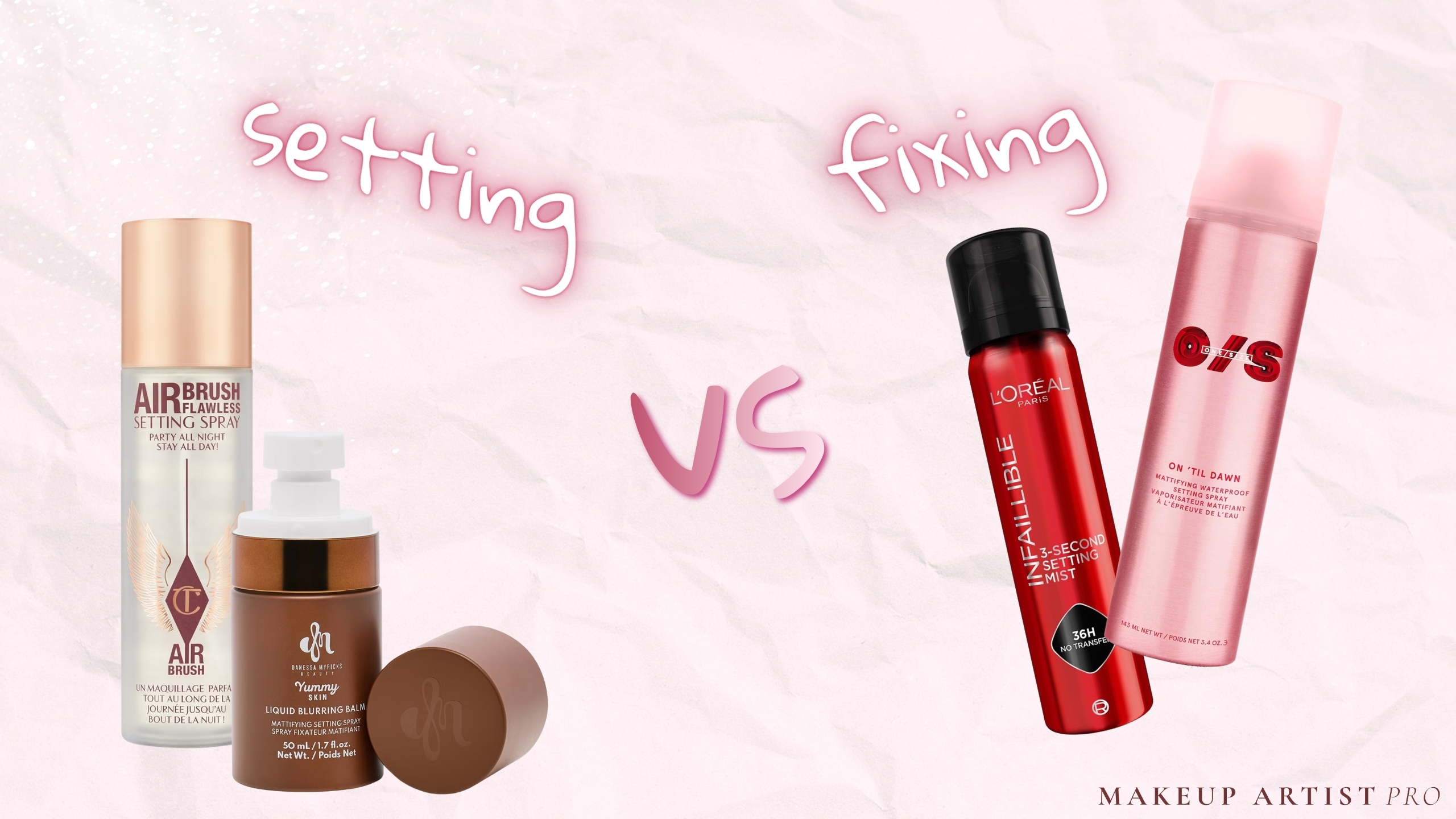
If you have ever stood in the aisle holding two near-identical bottles wondering what separates a setting spray vs fixing spray, you are not imagining the confusion. Brands use the two names almost interchangeably, yet they were designed to do two genuinely different jobs. A setting spray perfects how your makeup looks, while a fixing spray controls how long it lasts. Understanding that distinction can save money, frustration, and a lot of midday touch-ups.
Setting Spray vs Fixing Spray: The Core Difference
Here is the cleanest way to think about it. A setting spray is your makeup's stylist: it melts powders into skin, knocks down that flat, "made-up" look, and leaves a finish you actually chose, whether that is dewy or matte. A fixing spray is your makeup's bodyguard: it lays down a film of polymers (usually with a little alcohol) that seals everything against sweat, humidity, tears, and transfer.
The trouble is that in the US market almost everything on the shelf is labelled "setting spray," even the heavy-duty lockdown formulas. The terminology blur is real, which is exactly why this question gets asked so often. Functionally, though, every spray leans toward one of these two jobs.
Watch an MUA break it down. These two creators explain it perfectly:
What a Setting Spray Actually Does
A setting spray is mostly water-based and built around skincare-style ingredients: glycerin, hyaluronic acid, aloe, sometimes a touch of oil. When you mist it on, those ingredients let the layers of foundation, concealer, blush, and powder relax into one another so your face reads like skin instead of a stack of products. This is the step that erases the chalky, cakey look you get when powder just sits on the surface.
What a setting spray is not designed to do is dramatically extend wear. Most formulas hydrate and unify the finish. They are not laying down a heavy-duty seal. That is not a flaw. It is the entire point. A great setting spray makes you look freshly done, and you can even mist it mid-application to revive a powder blush or bronzer that has gone flat.
Setting sprays also come in finishes, and that is where a lot of the magic lives. A dewy formula adds the lit-from-within glow everyone wants for soft, natural looks, while a matte formula tames shine without flattening the whole face. A budget multitasker like Milani Make It Last hydrates and sets in one step, while air-powered continuous mists like the Morphe Lifeproof Continuous Setting Mist lay down an even veil with no splatter.
A setting spray is the only "spray" you should reach for during application. A light mist over baked-on powder melts it into the skin and instantly removes that dry, dusty finish.
What a Fixing Spray Actually Does
A fixing spray plays a different game entirely. Its formula leans on film-forming polymers (the same family of ingredients that lets a long-wear foundation stay put), usually paired with a small amount of alcohol to flash-dry and shrink that film into a tight, invisible mesh over your makeup. The result is a look that resists sweat, humidity, oil break-up, and transfer for hours.
That power comes with a trade-off worth knowing. The alcohol that makes fixing sprays so effective can feel drying, so they are not always the kindest choice for very dry or sensitive skin used every single day. They also lean fast-drying and often slightly matte, which is why they shine for events rather than no-makeup-makeup.
The category's icons are easy to spot. Urban Decay All Nighter (mini available) is the waterproof, transfer-resistant benchmark, labelled a "setting spray," but functionally pure lockdown. In the pro world, the truest fixing sprays by name are studio staples like Make Up For Ever Mist & Fix and Kryolan Fixing Spray, the alcohol-based mists artists keep in their kits for film, stage, and weddings.
If you only remember one line from this entire guide, make it this one. Setting spray is about the finish in the mirror. Fixing spray is about the finish eight hours later.
Setting Spray vs Setting Powder: Don't Confuse These Either
While we are clearing up sprays, the other product people lump in is setting powder. Powder and spray are not interchangeable: powder absorbs oil and locks concealer in place (especially under the eyes and across the T-zone), while a spray melts and finishes the whole face. Most long-wear routines use both: powder where you crease or get oily, then a spray to take the powdery edge off. I break the powder side down fully in the setting spray vs setting powder guide.
Setting Spray vs Fixing Spray: Myth vs Fact
A few stubborn myths keep this question confusing. Tap each card to see the verdict.
"Setting spray and fixing spray are the same thing."
Tap to revealThey overlap and brands name them loosely, but a setting spray is built to perfect your finish while a fixing spray is built to lock makeup down for hours.
"A setting spray makes your makeup last all day."
Tap to revealA pure setting spray mainly blends and finishes. It adds little real wear time. For genuine all-day hold you want a fixing or long-wear formula.
"Fixing sprays are usually alcohol-based."
Tap to revealFilm-forming polymers plus a little alcohol create the fast-drying seal, which is exactly why fixing sprays can feel drying on parched skin.
"Hairspray works as a setting spray in a pinch."
Tap to revealHairspray uses resins and propellants formulated for hair, not skin. It can irritate, clog, and sensitize. Use a product made for your face.
When to Use Each (and Can You Use Both?)
This is where the decision gets easy. Match the spray to the day, not to the hype. Tap each card for the move I would make.
Reach for a setting spray. You want comfort and a skin-like finish, not industrial hold.
Reach for a fixing spray, or layer both. This is exactly what it was built to survive.
A matte setting spray or a fixing spray keeps shine and slip under control when the air is working against you.
Lean on a hydrating setting spray. Use alcohol-based fixing sprays sparingly, and only on the days you truly need lockdown.
And yes, you can absolutely use both, in the right order. Setting spray goes on first to blend and finish the face, then fixing spray goes on last to seal it. Let each one dry before the next, and never spray-and-rub. What you should not do is mix the two formulas in one bottle. Their chemistries are built for different jobs, and combining them can pill or break down.
For brides and long days, this is the layering logic in action:
How to Apply Setting and Fixing Spray the Right Way
Even the best formula underperforms if you spray it like air freshener. The technique is simple, and getting it right is the difference between a flawless seal and a blotchy, half-dissolved face.
Hold it 20 to 30 cm away
Roughly the length of your forearm, wrist to elbow. Far enough that the mist drifts down like fine fog instead of landing in one wet spot. Too close and heavy droplets lift your makeup. Too far and most of it does not land on your face.
Spray in a T, an X, then an O
Mist across the forehead and down the nose for the T, corner to corner and cheek to opposite jaw for the X, then a slow O around the perimeter to blend the edges. Use far more than you think you need: six to ten light passes, built in thin layers rather than one soaking coat.
Then leave it alone
Let it air-dry on its own. No fanning, waving, blotting, or pressing it in. Touching the surface while it sets is the fastest way to break the very film you just laid down, which is the entire point of the product.
Before, after, or both
A spritz of setting spray before makeup preps and hydrates the skin so foundation grips better, and a spritz after sets and seals.
For a long event, setting spray goes on once your cream and liquid products are blended in (foundation, concealer, and any cream contour, bronzer, or blush), then fixing spray goes on last to lock it all in.
If you remember nothing else: spray, then walk away. Give it 30 to 60 seconds to dry before you touch your face, put on glasses, or pull a top over your head. The seal forms as it dries, and rushing it ruins it.
The Mistakes That Wreck a Good Spray
Most setting and fixing spray disappointments come down to user error, not the formula. These are the ones worth catching.
- Spraying too close. A bottle held 5 cm away dispenses fat droplets that pool, drip, and dissolve your work. Back up to forearm distance.
- Spraying over unset cream products. Mist over a fresh cream blush or dewy concealer and you can move or streak it. Set creams with a light touch of powder first, then spray.
- Drowning the face. More product does not mean more hold. An over-saturated layer takes forever to dry, slides around, and can leave spots as it settles.
- Fanning or blotting it dry. Waving your hands or pressing with a tissue lifts the film before it sets. Patience is the technique.
- Expecting a setting spray to add wear. If you need eight hours of hold, a hydrating setting spray was never going to deliver it. Reach for a fixing or long-wear formula instead.
- Using hairspray in a pinch. The resins and propellants are made for hair, not skin, and they can irritate and clog pores. Never on the face.
How to Choose: My Vetted Picks
Buy for the job you actually need. When the goal is pure lockdown (weddings, heat, photos, a 14-hour day), these three are the ones I trust most. The ONE/SIZE On 'Til Dawn and Urban Decay All Nighter are, hands down, the best in the category.
The Fixing-Type Sprays That Don't Budge
Maximum hold for events, oily skin, and long, sweaty days.
Patrick Starrr's shine-resistant, high-hold lock. For oily skin and long days this matte fixing spray simply does not move, one of my two favorites in the whole category.
The waterproof, transfer-resistant benchmark, sold as a setting spray but behaving like pure fixing spray. Sweat, humidity, and happy tears do not stand a chance. My other category favorite.
A fast-drying, no-transfer mist with up to 36-hour wear. The budget pick when you want quick, lock-it-and-go staying power in a single pass.
For everyday wear, blending, and that skin-like finish, the setting sprays below do the perfecting work, and a few moonlight as skincare.
The Setting Sprays That Perfect the Look
Blend layers, control finish, and keep skin comfortable, from drugstore to skincare-grade.
Alcohol-free, fragrance-free, and non-comedogenic, with an ultra-fine spa-like mister. The setting spray for skin that reacts to everything else.
A 24-hour hydrate-and-set multitasker you can use to prime or finish. The 4.5-star drugstore overachiever.
Hours of hold with a softer, hydrating finish rather than a flat-matte one. The luxe bridal pick when you want longevity that still looks like skin.
Air-powered and alcohol-free, this micro-fine mist forms a waterproof, sweatproof, transfer-resistant shield for 16 hours, yet stays nondrying with a comfortable, skin-like finish.
Skincare-infused and built to melt powder into a glassy finish. A glassy film-former plus ceramides extend wear up to 12 hours while hydrating.
A 4.7-star, award-winning "filter in a bottle." Powered by Upsalite, it mists on like a liquid but performs like a powder, blurring texture and mattifying without cake.
Two Sprays Worth Singling Out
Two of the picks above earn a closer look, for opposite reasons.
Saie CitySet is the rare setting spray I would hand to someone whose skin reacts to everything, and the difference is in the ingredient list. It is alcohol-free, fragrance-free, non-comedogenic, and plant-powered, a genuinely unusual combination in a category built on alcohol. Hydrolyzed corn starch sets makeup with a flexible, never-crispy hold. Humectants like propanediol and glycogen keep skin looking dewy and hydrated rather than tight. And a dose of mandarin (Citrus Reticulata) peel extract helps defend your skin barrier against daily pollution, all while claiming up to 16 hours of wear from a non-aerosol mister so fine it feels spa-like. If most sprays leave you stinging, tacky, or broken out, this is the one to try first.
And then there is the spray I reach for between steps rather than at the very end. The Rare Beauty Always An Optimist 4-in-1 Mist (mini available) is not built for heavy lockdown, and that is exactly the point. The bi-phase mist is astonishingly fine, dosed with niacinamide and sodium hyaluronate plus a soothing botanical blend, and it carries the lightest, most luxurious whisper of fragrance that honestly feels like a spa moment on the face. I use it to hydrate before makeup and to melt powder layers into the skin mid-application, so the finish never looks built up. Buy it for the comfort and the glow, not for an eight-hour seal.
If you are building a wedding-day kit specifically, the spray you pick is only one piece, so see how it fits the full timeline in my wedding makeup prep guide.
Quiz: Setting Spray or Fixing Spray?
Test Your Setting Spray IQ
5 questions. Setting spray or fixing spray: do you actually know the difference?
Frequently Asked Questions About Setting Spray vs Fixing Spray
Not quite. They overlap, and brands often use the names interchangeably, but a setting spray is formulated to perfect your finish and melt layers together, while a fixing spray uses film-forming polymers and alcohol to lock makeup down against sweat, humidity, and transfer.
Not really. "Finishing spray" is the loosest of the three labels and has no fixed industry meaning. Some brands use it for a setting spray, some for a fixing spray, and some for a glow or blur mist that changes your finish without adding much hold. Whatever the word on the bottle, the product still does one of the two real jobs: perfect the look or lock it down. Judge it by the formula and the claims, not the name.
Yes, and it is a great combo for events. Apply the setting spray first to blend and finish your makeup, then the fixing spray last to seal it. Let each one dry fully, and never mix the two formulas in a single bottle.
Only a little. A pure setting spray mainly improves how your makeup looks and feels rather than dramatically extending wear. If your goal is genuine all-day staying power, choose a fixing spray or a long-wear formula like Urban Decay All Nighter.
No. Hairspray contains resins and propellants formulated for hair, not skin, and it can cause irritation, clogged pores, and sensitivity. Always use a spray made specifically for the face.
It is sold as a setting spray, but functionally it behaves like a fixing spray: it is waterproof, transfer-resistant, and built for long, sweat-proof wear. It is a perfect example of how loosely the US market uses the term "setting spray."
Powder absorbs oil and locks products like concealer in place, especially under the eyes and across the T-zone, while a spray melts powder into skin and finishes the whole face. Many routines use both. See the full breakdown in our setting spray vs setting powder guide.
The Bottom Line: Buy for the Job, Not the Label
The setting spray vs fixing spray debate is not really a competition. It is a division of labor. A setting spray makes your makeup look right the moment you finish, and a fixing spray makes sure it still looks that way hours later. Once you stop reading the front of the bottle and start asking "do I need a better finish, or longer wear?", the choice makes itself. And on the days that demand both (weddings, heat, photos, tears), you now know the order: blend, then lock.
Setting spray for the look. Fixing spray for the long haul. The pros just use both.